 |
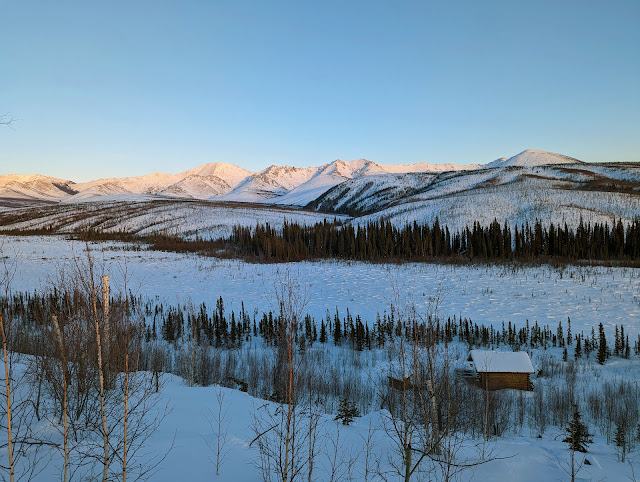
| Evening at Wolf Run cabin, March 2023. |
Alaska's White Mountains have the cure for what ails you. Don't believe me? How many places in this world are so accessible and yet still so wild? So rugged and primitive and yet infused with promises of comfort and peace? So cold and distant that quiet is all but assured and sublime beauty is guaranteed? There are many places like this, I suppose, but the White Mountains seem custom-designed for me.
I discovered this place through the White Mountains 100, my favorite race. Miraculously this event has survived four different race directors and two pandemic-related cancelations. It's been four years since the last time I raced and I wanted to return in 2023. Really, I did. But the sign-up period in November was not a good time for me. Not at all. My mental health was crashing, and then I physically crashed while trail running, sustaining injuries that lingered for weeks. A large part of me wondered if I'd ever get up again.
Just as I started to come around, the 2023 event was already here. Corrine had formulated a fun adventure to ride the classic loop backward (with bonus spurs) over four days and photograph all of the racers we encountered on day three. She invited Betsy and me. While I resisted for a strangely long period of time, by the time I got on board, I was giddy with anticipation. Since I've been writing such long posts about the White Mountains, it seems a good time to sum up my history with the race that started it all for me:
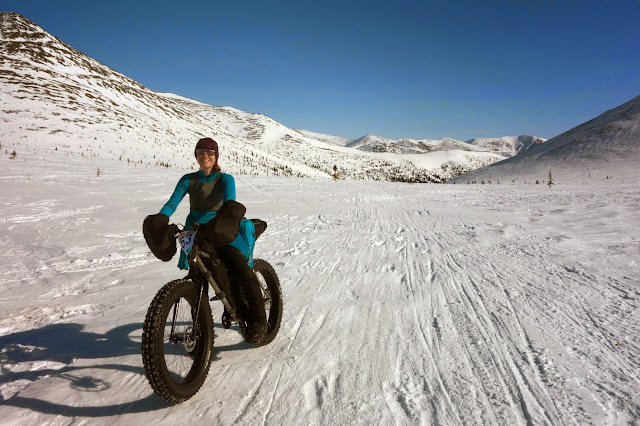 |
| Possibly my best-ever day on a bike, the 2014 White Mountains 100. |
A somewhat-brief synopsis of my history with the White Mountains 100:
2010. My life was in shambles. I was depressed and grieving a failed relationship, which led to a rash decision to leave my intolerably stressful newspaper job without a solid plan for the future. Another important change I decided to make during this time was to quit endurance racing, which had unquestionably complicated all of my problems. The day after I put in notice at my job — coincidentally — I received an e-mail from a Fairbanks friend who was starting a new 100-mile race in the White Mountains. No one from Juneau had signed up yet, and Ed wanted to round out the roster. I showed up two weeks later to bike a course with endless hills, ice, overflow, and temperatures dipping to 25 below. I finished 14th overall in 22 hours and 23 minutes.
2011. Signed up again and invited my new love interest, Beat. He initially agreed but then balked at the biking part of our plan. I finished in 17 hours and 55 minutes. Beat needed 35:41 to get around the course without the aid of a bike.
2012. Again with a bike and several inches of new snow. Finished third woman in 20 hours and 47 minutes.
2014. After training all winter to complete the Iditarod Trail Invitational 350 on foot, I took a bike to race the WM100 for fun, fatigued and undertrained as I was. Frighteningly fast trail conditions made it almost no effort at all to finish in 11:34. I felt amazing! But this was the only year I didn't "podium" as the fourth woman. I blamed ITI legs.
2015. Decided to complete the course on foot. I lost all of my gear to the U.S. Postal Service before the race and had to buy a bunch of stuff last-minute at Goldstream Sports, including shoes. Beat wanted to join and "paced" me self-supported, but I ended up dropping him (poor guy, he'd had an unbelievably tough year at the ITI.) I just barely skirted under 30 hours in 29:54, the third woman on foot.
2017. Thyroid disease prevented me from racing anything that winter, so I volunteered for the aid station at checkpoint one. It was a frigid year and we had to stand outside for five hours. All of the soda froze solid and we ran out of water, so I had to melt snow on a propane cooker.
2018. Returned to race on foot as a true glutton for punishment, having finished the ITI 350 on foot just two weeks earlier. I was finally starting to understand the depth of strain that sled dragging puts on my body, but not in time to start a 100-mile ultramarathon without some of the worst leg pain I've experienced. 33 hours and 59 minutes of pure hurt. And no, it never went numb. But the incredible Northern Lights display made everything worth it. Alaska runners Teri Buck and Laura McDonough once again put me to shame at a distant third.
2019. This was to be my year. The White Mountains 100 was my A race. I wanted to crush my 100-mile PR — 27 hours? 26? Not outside the realm of possibility! I trained hard all winter, spending a month in Nome where practically all I did was train and pretend to write. Trail conditions were superb and I made it to the halfway point, Cache Mountain Divide, with daylight to spare in 13 hours. But then it started to snow. It snowed eight inches overnight. And everything fell apart. I was again the third woman on foot, finishing in 31 hours and 22 minutes.
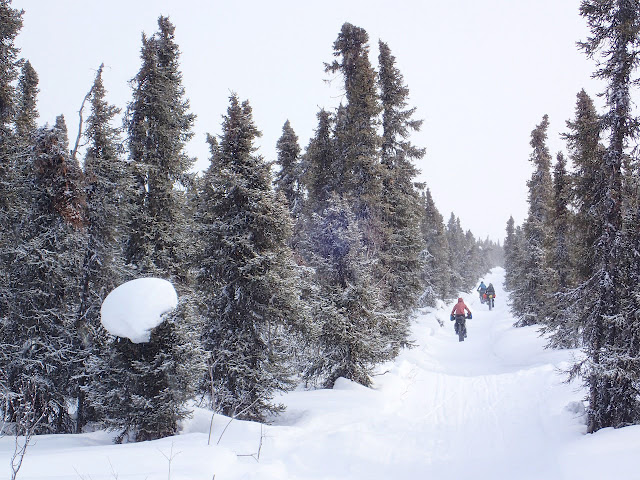
For so many years, I showed up at the White Mountains with my life or body or spirits in some sort of shambles, and the White Mountains never failed to provide triumph and revival. (Except for 2019. That year can go to hell.) I was grateful to Corrine and Eric for making this tour possible, and to Tyson for the generous offer to lend a fat bike to a stranger. Since nearly all of our Christmas trips have been on foot, it's been a hot minute since I've ridden a bike in the Whites. So fast! So fun!
Skies were overcast with light flurries and occasional breaks of sunlight. There was about an inch of fresh powder over the trail base, which had firmed up considerably since I hiked this way two weeks earlier. It took us about an hour and a half of leisurely pedaling to reach the mile 11 trail shelter, where I reminisced about the five-hour battle I'd endured to reach this point on March 10.
"Bikes sort of feel like cheating," I mused to Corrine.
The light was flat and featureless, making for more difficult navigation because the trail base was never obvious. We started using the term "Braille Trail" for lines we had to feel out with our wheels, moving as slowly as necessary to gauge the path. Corrine likes to surge ahead but eventually became frustrated with doing all of the navigation, so we took turns leading.

There was one brief section of overflow at the Wickersham Creek crossing. I became more alarmed than necessary — one of my first indicators that anxiety, though meaningfully diminished, was still with me. In my defense, I'd seen overflow here two weeks earlier and the fact the area was still wet meant there could be rotten ice. We could even see flowing water through a couple of holes in the ice. Of course, this is a small creek and even breaking through to the bottom was likely to be thigh-deep at worst, and there was a cabin nearby, and the air temperature wasn't all that cold. Still, I trembled as I pulled on my waders while Corrine bravely scouted the crossing.

A leisurely lunch at Borealis cabin, a few more pedal strokes, and suddenly we were at Caribou Bluff — the cabin I'd failed to make two weeks earlier because I was so shattered after walking 19 miles in 9 hours. This time, we reached the mile 28 cabin with energy and daylight to spare. I hiked to the ridge to take photos of Eric and Betsy approaching the cabin.
Skies cleared and the sun came out for early evening libations (I was down to the last of the cinnamon tea that Mark donated to my hiking endeavor during my first White Mountains trip. I would have killed for an afternoon coffee, which I'm still depriving myself of on orders from my therapist.)

Eric seemed somewhat indifferent to the biking part of this trip (he admitted that he doesn't love long sloggy rides) but relished in the cabin chores. These chores include gathering, sawing, and stacking an impressive haul of firewood. I tend to be lazy when it comes to this tedious labor and will opt to spend long hours on the trail and then wear my puffy suit inside cabins just to minimize the need for indoor heat. Eric, on the other hand, carries snowshoes and a hand saw on his bike and will gleefully stomp into the woods to find the best stashes of "standing dead" black spruce trees. I felt some obligation to help him out and did enjoy the hauling part of firewood collection — the best part. These trees don't look so large, but they're heavy, and hoisting them through thigh-deep snow without snowshoes made me feel like a badass.

The sunset was subtle but lovely. As skies cleared, temperatures began to plummet. It was 5 below by the time darkness fell. The four of us squeezed into the tiny cabin, not much larger than a typical walk-in closet.
Top bunks don't treat me well, and I tossed and turned through a lousy night of sleep. But the benefit of insomnia in Alaska is more opportunities to catch the elusive Aurora Borealis. This display erupted suddenly when I was already outside and walking along the trail to burn off some insomnia jitters without disturbing the others in the tiny cabin. I wasn't quite dressed well enough for an extended stay in the 15-below night without mittens or a hat, but I tucked my hands into my coat to warm them enough for a few phone photos.
Witnessing the lights dance over these jagged limestone summits is a spiritual experience. My brain sent out subtle warnings that my hands and feet were in trouble (I was also sockless in my hiking boots, having failed to locate my socks in the dark.) But in my mind, there was a powerful urge overriding these signals, a drive to sprint toward the northern horizon and throw my arms into the air to release the bursts of joy that demanded to be freed.
Corrine and Betsy had expressed a desire to be woken up if the lights were out. I regret not doing so, but in my defense, I was reluctant to disturb anyone's precious rest when sleep had been so elusive for me. By the time I made my way back to the cabin — shooting one last photo before my fingers stopped working entirely — the aurora faded as quickly as it began. My friends, rising to use the outhouse at other hours of the night, reported that the lights didn't seem to come out again.
Even lacking sleep, it had been a beautiful night and I felt revived the next morning. It was a short 10 miles to our next cabin, and I was already scheming bonus miles (maybe to avoid those tedious cabin chores. You'll never prove it, Eric!) Temperatures hovered around 10 below as I pedaled up Fossil Creek. I know it's a good morning when the individual hairs on my nose freeze.
The Fossil Gap Trail was a new-to-me route, one of the few connectors in the White Mountains Recreation Area that I had yet to travel. It was fun to explore new territory, so I used the excuse of bagging other new-to-me trails to extend the day's ride — the Colorado Creek Trail, and if I had time, the Big Bend climb all the way to the point on the ridge where I gave up and turned around during a day ride back in 2013.
It was such a lovely day, and the trail conditions were superb. I knocked out the 9 miles to the junction in just over an hour. The temperature had risen to 0 degrees. In the high March sunlight, it felt oddly warm, even hot.
I continued another 12 miles, starting with the gradual climb along Colorado Creek. This broad valley is windswept and desolate with only a few patches of stunted spruce trees to break up a daunting expanse of white. Lacking wind protection, the faint trail is rippled with sastrugi. I don't think the Big Bend Trail sees much use and is probably almost always buried in drifts. A soft base with endless collapsing speed bumps makes for strenuous pedaling. I was feeling strong and determined to stay in the saddle as long as possible, so I queued up a 10-minute-long song by Metric, "Doomscroller," which includes a fast-paced repetition of the line "Don't give up."
I'm a true doomscroller
I can't seem to shut it down
Until the worst is over
And it's never over ...
A couple of miles past Colorado Creek cabin, the route makes a sharp left turn to take the direct route over a ridge dividing Colorado Creek and Beaver Creek. In two miles the trail gains nearly 1,000 feet of altitude, topping out with impressive views of a wilderness that stretches a hundred miles to the Yukon River and beyond. I had burned most of my energy matches battling the wind drifts, but was still determined to reach the summit, so I left Doomscroller on repeat. For a song that starts so mean and despondent, it segues beautifully into a soft, hopeful redemption. As I marched, I breathed out the lyrics that I'd come to hear as a reflection of my own mental health recovery.
Take this for the heartache
Not some cure to negate it
More like a magnification mirror, full-size
Inner reverberation happens outside.
I left the bike at the last tripod on the hillside. There, the trail steepened to a veritable headwall, and I thought I might need my hands free to crawl up it. Finally, I gained the ridge and continued hiking along the broad spine to the high point, a place where I remember turning around during a 70-mile day ride in 2013, having determined that this trail was ridiculous. Strange that another ten years passed and I still hadn't attempted to link it together. Or perhaps it's strange that I'm still here, walking this remote and foreboding ridgeline, ten years past a point of no return.
A Snicker's bar restored my energy (I was still trying to choke down my two-week-old trail mix with limited success, but I did bring some candy this time.) When Metric revved up the tempo, I started running, punching deep boot holes in the barely-there trail. When the song neared its refrain, I surprised myself by bubbling over with emotion, dropping to my knees, and releasing an ugly, snot-soaked cry that I now recognize as sudden grief.
Whatever you do,
Either way, we're gonna love you,.
Never mattered,
Either way, we're gonna love you,
Never mattered,
How many or how much more you've been through.
It struck me that the love I feel in these wild, frozen, foreboding spaces is the dream of universal love, a love that stretches beyond embodiment, beyond time, beyond even the great and unknowable ... beyond. For all of our striving, isn't this all any of us want — to feel a love we know can't be lost, and to feel worthy of such love? Strangely, out here in a place so inhospitable to life including my own, I understand that I have this love, that I've always had this love, that I am this love.
When grief finds me, I understand this love all too well. It is pain as much as it is joy, because embodiment means accepting that everything is impermanent. It was all so intense that I felt weak in every muscle, briefly wondering if I'd find the strength to stand. The intensity of emotion washed over me and I mustered the final steps to the high point. Up there, I experienced a clarity of mind and vision so different from the brain fog that still hangs heavy over my memories of this winter. It was as though I'd been splashed with cold water and was finally waking up.
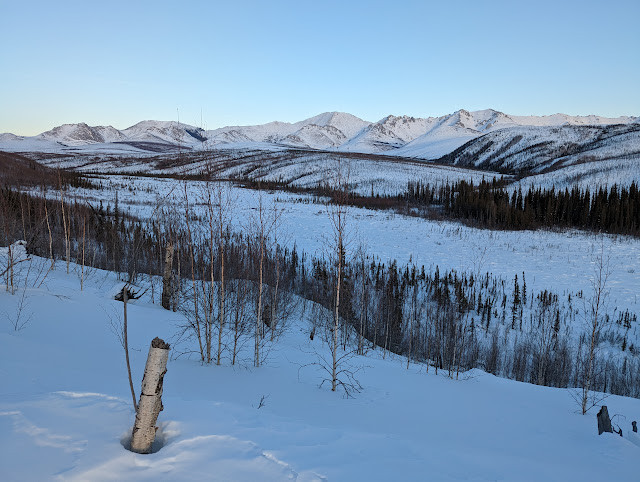
The ride back to Wolf Run cabin was nearly all downhill with a tailwind, and I was feeling triumphant after the emotional cleansing. It was somewhat difficult to switch back from "seeking the wisdom of the mountains" mode to social mode, so I spent a bit more solo time sitting outside on the porch with my stove, melting snow. Wolf Run was in a gorgeous setting and I wished I could move here and live out my days in a tiny cabin, melting snow or collecting water from creeks, subsisting on berries and rice and lentils, collecting downed trees, and chopping wood. I don't love chopping wood but I would learn to love it just to spend my life with these wise mountains.
It was fun to return to the warm indoors and have lighthearted conversations with my friends. Day three was to be a long day — 45 miles with 4,000 feet of climbing — so everyone was motivated to go to bed early. I finally got a good night of sleep, with just one trip to the outhouse to scan the sky for Aurora. There were subtle hints of green light to the north, but most of the sky was already obscured by high clouds.
In the morning, we started out on another new-to-me trail, Windy Creek. This trail is gorgeous, climbing through a narrow valley beneath forested hills and jagged limestone spires.
The trail skirts over a saddle at Windy Gap before descending to connect with Fossil Creek Trail and the classic White Mountains loop. The race had started earlier that morning, and we expected to see our first racers soon.
Our group was a little more staggered on this day, with Betsy setting out first and Corrine and Eric determined to photograph every one of the 80-something racers on the course. I was a little nervous about navigating such "crowds," but 80 people and a few volunteers on snowmobiles are not actually all that many people when stretched out over 30-something miles. It was still a quiet ride and a lovely day despite the gray skies.
When high noon sunlight finally did break through the clouds, the colors were subtle but surreal. In this photo, I was battling my way across the "Ice Lakes," which had drifted with shin-deep snow. A strong headwind swept down the valley, stirring up more powder. Two snowmachines passed and within minutes their tracks disappeared.
The difficulty eased as the trail pitched upward toward Cache Mountain Divide. I spent about a half hour on the summit, snacking on crackers and waving at racers as they passed.
Corrine approached and we started the descent together.
We pulled over for dozens of racers. This is the lead woman Ana, who was the only biker I saw running while pushing her bike up the steep and soft final pitch to the Divide. Impressive.
A few miles down the trail, I stopped for a biker I didn't recognize until she said, "Oh, hey, Jill." I was surprised to realize it was Missy Schwarz, who is one of the few women to have finished the 1,000-mile Iditarod Trail on a bike. I asked her how she was doing and she said, "I've never been in so much pain in all of my life."
This, too, was a surprising statement from someone who has ridden a bike to Nome, so I scrunched my forehead in confusion. "What? Why?"
She pointed to a jagged wound on her cheek, crossed with fresh stitches. "Stabbed myself in the face two days ago. Fuck it hurts."
Despite the fact she was racing, she stopped for 10 minutes to tell me the long story about how she was using her knife as a tire lever while tuning up her bike, how she felt it slip and watched the blade fly toward her face, how she missed her only good eye by inches, and fun fact, her other eye is nearly blind from a past bout with a virus.
"Damn, that could have been life-changing," she mused, laughing about nearly becoming fully blind as she pulled out an eight-pack of mini powdered donuts and proceeded to eat all of them.
"I'm really bonking but it hurts to chew," she mumbled as white powder puffed out of her mouth like snow. "This was a dumb thing to do; why do we do such dumb things to ourselves?"
I shrugged. I was admittedly feeling envious. Not about the facial wound or terrible pain, but I was starting to wish I was a racer moving toward the long night. But I love Missy. The fun encounter made my day, and apparently, the powdered donuts made hers.
"I felt a lot better after that," she told me later. She'd go on to finish strong in less than 15 hours.
The fun racer encounters continued, especially when I got to the runners, who were generally more than ready for a break at mile 30-something and willing to stop and chat for several minutes. I was feeling genuine FOMO for the White Mountains 100, which is such a fun scene. I do hope I have the opportunity to return again. I am going to find that perfect run, mark my words!

Our last cabin was Crowberry, which is at the top of a bluff nearly a thousand feet higher than the crossing at Beaver Creek, with a fair number of rolling hills in six miles. Corrine, ever the optimist, had told Betsy that the ride was "all downhill" from the Divide. I'm not sure I got my warning out that the route is absolutely not all downhill from there, but since I know and already love this part of the trail, I didn't mind the climb. I had a nice chat with the sweeper for the race, who was napping in the cabin when I arrived. He was wearing a WM100 hat from 2012 and told me he used to work the 80-mile aid station, where he was always flabbergasted at the horrible condition of the runners who stumbled in and languished at the cabin. I have been a part of all of that scene, from the 2012 race to being a sad runner at Borealis, so I was a little bit hurt when he didn't remember me at all.
That evening, everyone trickled in slowly, with Eric arriving more than two hours later. I moved as much wood as I could into the cabin, started a fire, and melted a pot of water for the group to use for dinner. Betsy arrived with wet base layers and a somewhat shell-shocked demeanor but seemed to perk up as soon as she got out of her wet clothes and had something to eat. Just as the gray sky faded to dark gray, flurries started to fly. I checked the weather on my InReach and saw that the forecast for the region was calling for 3-5 inches of snow on Monday. I didn't tell my companions because while some information is good — like knowing about the thousand-foot climb at the end of the day — some is just going to wreck a night of sleep. If it snowed, it snowed, and there wasn't much we could do about it now.
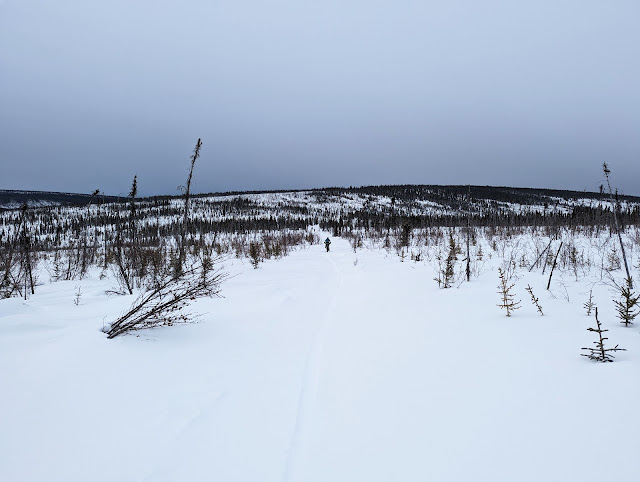
Indeed, we woke up to about two inches of fresh powder in the morning, covering up a trail that had considerably softened in warm temperatures and heavy traffic the previous day. Betsy was stressed. We had 26 miles to ride back to the trailhead, and she was convinced we'd push our bikes the entire way and she'd miss her midnight flight, which was also when I was flying out. Her worry was understandable, but it wasn't exactly my dilemma (missing my flight would be a hassle but not that bad. I missed Beat, who had been home for several days after returning from his seventh successful walk to Nome. But there was nothing pressing on my schedule, and I certainly don't mind walking 26 miles. I'd have probably come here with my sled if I thought I could make the mileage.)
Still, because Betsty was so worried, my own anxiety seemed to absorb the negative energy. Suddenly I felt jittery and nervous. I even began trembling. It's so strange to experience something like this — to tell yourself that you're actually not scared, that it doesn't matter, but have your body reject this truth and launch the panic response anyway.
Everyone perked up after we left the cabin and discovered that the trail was still reasonably rideable. Drifting snow meant we had to hike most of the climbs, and the trail was often impossible to pick out of a blank expanse of white — true Braille trail. We traded the lead for a while, but after a long descent, I ended up in front. I found navigation to be a rewarding game — puzzling out my line in the powder, sometimes choosing poorly and toppling over, but more often feeling like I was zipping through the clouds, dipping and weaving along an invisible path.
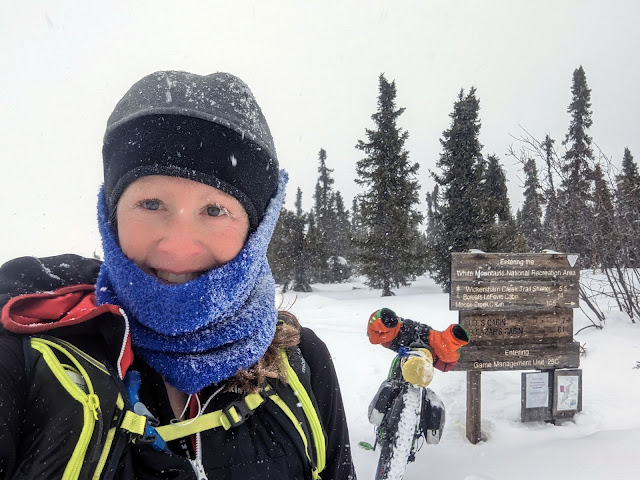
By the time I finished the last long climb to the intersection with the Wickersham Wall, I was in a great mood. It had been a fun day, and now the snow was coming down hard and that was exciting. This Monday of the White Mountains 100 was so much like my Monday in 2019, with the unexpected dump of fresh powder and Braille trail that upended my race. But now I had no animosity, and it felt like redemption in its own way. That year can still go to hell ... yet, isn't this what we seek from these wintry landscapes? We can prepare and plan and train to the heights of our human ability, but nature has the final say.
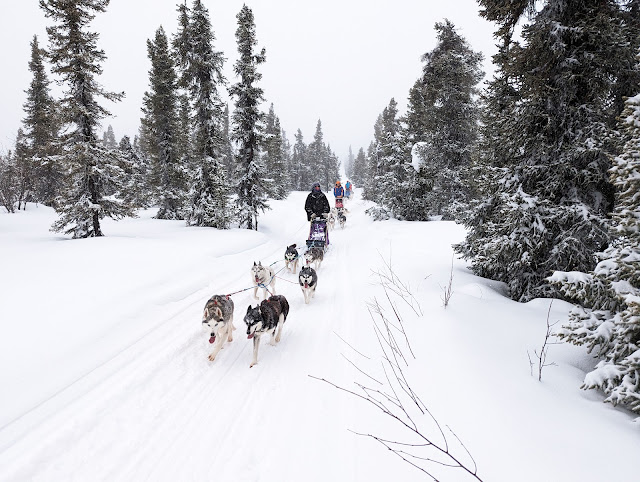
From what I gathered later, Betsy did not feel the same way and was ready to be done with the "most miserable day ever." I admit that I worked for years to reach this level of Zen. There's little left in the White Mountains to surprise me, and thus little left that can break me ... except for overflow, for which I retain an irrational fear. But it was empowering to realize this — a foreboding winter landscape can't break me. So why do I let my anxiety break me? It's a difficult lesson to hold onto when the sea monster has wrapped its tentacles around me, but it's true.
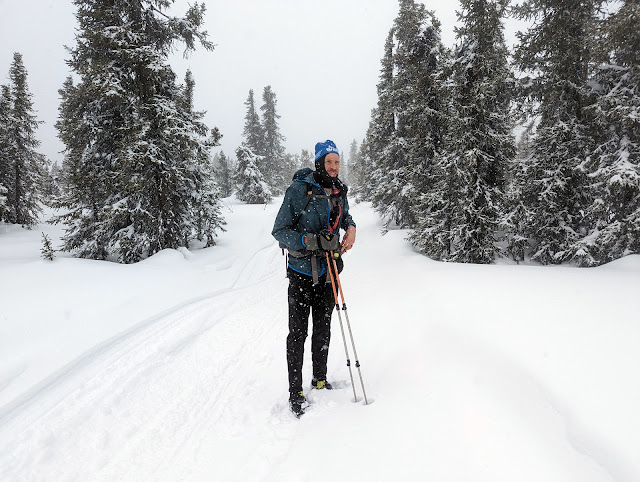
Just over a mile from the finish, I had my second encounter with my friend Tom, who was running his first-ever 100-mile ultramarathon in order to complete the White Mountains "trifecta" (finishing the race by ski, bike, and foot.) The Monday snow had upended his race as well. He was behind his hoped-for pace and "in so much pain." I regarded him with the deepest empathy — I have been there, standing right there, in this exact spot, and at nearly the exact same time of day, feeling something very much like what he seemed to be feeling. There is also great freedom in running a hundred miles. It hurts — so damn much — but it too doesn't break you.
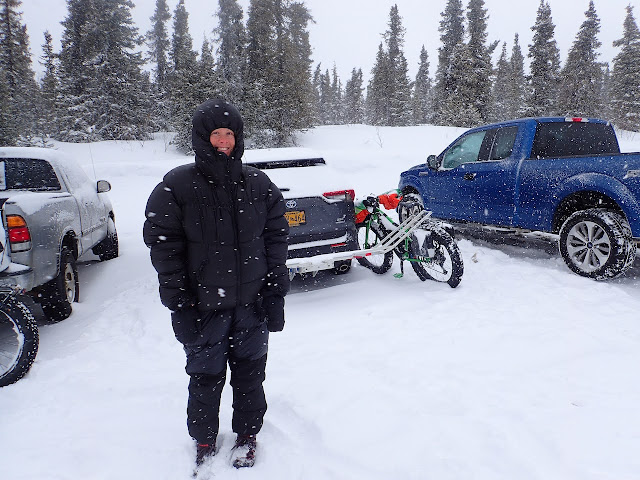
Ultimately it took about six and a half hours to ride the 26 miles out. Thick, wet snowflakes came down hard for the final hour, absolutely soaking everything I was wearing. These warm storms can be so deceiving because once you're wet, 32 degrees with a light breeze will feel like the coldest weather ever. I arrived at the trailhead about an hour before my friends. Even after stripping everything off and pulling my puffy suit over my naked body, I was still freezing. But I enjoyed waddling around and chatting with volunteers at the finish line.
This long, meandering blog post doesn't have a moral. Writing it was mainly an excuse to relive this trip, which was so rewarding with the perfect mixture of fun bike riding with friends, cabin relaxing, introspective slogging, and reminiscing about my favorite race. I am so grateful to Corrine, Eric, Betsy, and Tyson for giving me this gift. I may not be cured of mental strife, but I feel better than I have in a long time.