Monday, September 24, 2018

Valleys and peaks

After a night of working on deadline, I managed to sleep between 6 a.m. and 8 a.m. Wednesday before stumbling out of Zinal's blinding sunlight. This morning brought troubles finding Beat's snacks — the village grocery store was closed, and two convenience stores on the highway only had the low-quality, triangle-shaped sandwiches, and no chocolate milk or Apfelschorle. Driving through the busy hub city of Sion, GPS became confused, or I became confused, but I ended up stuck in a long tunnel that spit me out who knows where, and then I drove in the wrong direction for 20 minutes before seeing a road sign that I recognized. I thought I wouldn't make it to the next life base in time. My heart raced with out-of-control stress. 

Despite the setbacks, I managed to arrive at the Grande Dixence dam about ten minutes before Beat woke up from his nap there — I'd negotiated not being at the life base when he arrived so I could grab that two hours of sleep. It sounds silly now that I was so stressed about meeting him simply to deliver sandwiches and words of encouragement, but he had issues with the food offered by the race organization, and inability to take in any of the available foods can have a large negative impact on one's race. I thought it was important to be there for Beat, and he thought it was important too, although I never let on how much I was struggling with all of it. The sleep deprivation and cortisol had gotten to me.

My thoughts began to scramble in disconcerting ways. I couldn't piece together the simple multiplications for Beat's arrival times. Road signs that I had taken the time to Google and learn once again made no sense to me. I drove a fair distance up the no-public-access dam road before realizing my mistake and retreating with my heart racing yet again, terrified because I'd broken a rule in Switzerland. The only available public parking was a full 400 vertical feet below the hotel that hosted the life base — an impressive 10-story building in the shadow of the tallest dam in Europe, 935 feet of concrete grandeur. I lugged a huge duffel of supplies up the steep path to the hotel, hoping I didn't forget anything, because any return trip to the car involved a 30-minute hike.

Beat was still in impressively good shape at kilometer 200, although he complained of nagging knee pain, sleepiness because there weren't many spots to nap outside of the life bases, and then there was the issue with the unappetizing food that limited his energy intake. He was still traveling with Dmitry, and they seemed to have formed a good partnership. It appeared that they were swiftly moving up in the ranks, although it was impossible to know, since the only rankings the Swiss Peaks organization posted — screen shots of a spreadsheet on Facebook — were unreliable. They had several people listed as dropped who were not, including Beat at one point, and often had him listed last because he had the second-highest race number. Completely useless. There were a lot of things the Swiss Peaks organization did well, but where it mattered to me — a crew person — they were not all that helpful.
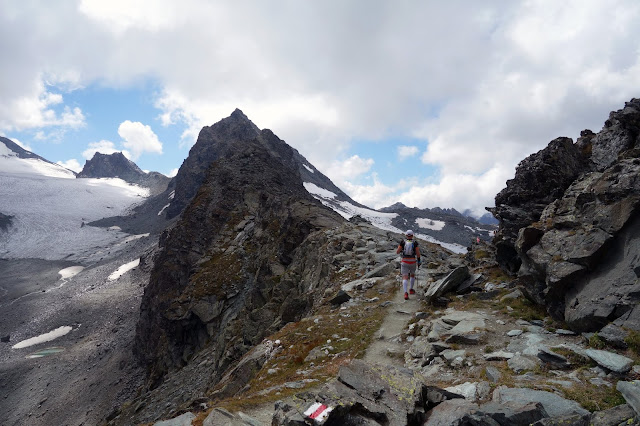
There were some fantastic kilometers in the Swiss Peaks 360. Beat can report that it was not all wonderful — there were a lot of excessively steep and loose, overgrown, eroded and poorly defined trails on that course. I was lucky to cherry-pick some of the best sections, including Col de Praflueri, one of the highest points in the race at nearly 3,000 meters.

I hiked to this col about an hour behind Beat and Dmitry, after I lugged the big bag of supplies down to the car and picnicked with a triangle sandwich that Beat had rejected, and delicious fresh fruit and bell peppers that I bought from one of the convenience stores. I was feeling worn out from all of the running around that morning, and hiking was my best way to re-energize. The setting was spectacular, with torrents and glaciers and fiercely jagged peaks knifing through a vast landscape that photographs never adequately depict. Hiking was always the best part of this week. Amid the stress and fatigue, whenever I was hiking, I never felt tired.

Marching up to the col, I encountered a number of Swiss Peaks runners who looked justifiably weathered, gazing back at me with their thousand-yard stares. Along this steep and rocky ascent I was listening to Twenty-One Pilots on my iPod, and adopted "March to the Sea" as my theme song for the week. I think this song is meant to be a metaphor for life's rat race, but taken more literally, the lyrics fit well with some of the worst elements of mountain endurance racing.

There's miles of land in front of us 
And we're dying with every step we take 
We're dying with every breath we make 
And I'll fall in line. 

A stranger's back is all I see
He's only a few feet in front of me 
And I'll look left and right sometimes 
But I'll fall in line. 

No one looks up anymore 
Cause you might get a raindrop in your eye 
And heaven forbid they see you cry 
As we fall in line. 

And about this time of every year 
The line will go to the ocean pier 
And walk right off into the sea 
And then we fall asleep.

After Col de Praflueri I made a weird choice to not descend the way I came, but instead cross a somewhat sketchy waterfall and pick my way across a steep boulder field to traverse over to another pass, Col des Roux. This afforded lovely views of Lac des Dix, a pale turquoise body of water beneath sheer cliffs, all above 2,000 meters. 

I scrolled through the map to see if there was a way to loop this hike, and noticed a trail descending to the lake perimeter, lined by a secondary dirt road (the red-colored roads on the map were usually quite rugged.) The map showed a quarter-mile-long tunnel near the dam, and I wondered if it was pedestrian accessible or could be bypassed. There would be a long, long backtrack if it wasn't, but hiking is better than driving.

The tunnel carved right through impressive cliffs, absolutely not bypassable. The tunnel itself looked open to hikers, but it wasn't lit. Sections of the tunnel opened up, so it wasn't a quarter mile of darkness, but there was one long section where I could not see the other side. Again I was stupidly not traveling with a headlamp (I nearly always do, and seem to only neglect to do so when I actually need one.) If I was smart I would have remembered that my phone can operate as a flashlight, but I was not smart on this day. I was actually quite addled, so much so that my plan to walk in a straight line and feel out the ground with my trekking poles crumbled as soon as I bashed into the side of the tunnel with my shoulder. Then I hit the other side of the tunnel, and then I ran into a wall head-on. The total darkness was deeply disorienting, and I realized that I could be turned around. I wouldn't even know. I could just keep walking in circles indefinitely and never escape this tunnel.

This realization prompted a real claustrophobic panic that would be quite funny if you weren't the one experiencing it. From this panic came a decision to walk with one hand pressed against the wall, hoping that if I came out on the wrong side of the tunnel, I'd know, and if I tripped over something, oh well. Finally I saw the light at the end of the tunnel. Just as I was about to emerge, another group of pedestrians approached and flipped a switch near the entrance. Overhead lights flickered to life. Oh. I see. Those exist. Well, duh.


Again I slept terribly on Wednesday night. In writing this blog post, it took me a while to piece together where I even stayed. All I remember is sleeping in dreadful fits where I woke up a number of times having drenched myself and bed sheets in sweat, then tossing for hours. This all happened during the time I unintentionally forgot to take my thyroid meds, which makes me wonder if some of these typical hyperthyroid symptoms were a result of this. But now I had insomnia on top of my other issues, and the whole world was looking more abstract every morning.

At some point before dawn I drove, thankfully without issue, to Champex. I actually managed to find good sandwiches along the way, although I have no memory of stopping anywhere. This life base was staged inside of drafty UTMB tents, still in place two weeks after UTMB. A cold morning wind rattled the plastic walls, and the interior temperature couldn't have been higher than 50 degrees. I wandered off to a nearby hotel and found a nice Swiss lady to make me a coffee, the first I'd had in at least three days — to-go coffee is not a common thing in rural Switzerland, and this was the first I'd taken time to just sit down with it.


For Thursday, I'd made plans to meet up with my friend Jenn and hike in Champery, the location of Beat's next life base. Jenn is an archivist from Whitehorse, Yukon, who is currently working on contract for the United Nations and living in Geneva. She just happened to have Thursday off for a Swiss national holiday, and her timing could not have been more serendipitous for me. Spending an afternoon speaking English with another person while doing normal and relaxing activities was everything I needed to get out of my own addled head and not go completely nuts. I picked Jenn up at the train station at Saint Maurice. We enjoyed pretzel sandwiches and another coffee (two in one day!), then toured a centuries-old abbey before continuing on to Champery.

The weather closed in and it began to rain, which prompted my deepest apologies (it's been beautiful all week!) I wasn't planning much of anything ahead at this point, and hadn't found a good trail to hike in Champery. The tourism office was closed, so we ended up buying a round-trip ticket for the tram to save 3,000 feet of climbing, then took a trail recommendation from a mountain biker. The biker's recommendation was of course a mountain bike trail, which turned out to be incredibly steep and slicked with mud (rated black diamond on a trail map we looked at later.) This was less than ideal and by far my worst hike all week, for which I also apologized to Jenn. She took it in good humor. We were just out for a jaunt and the scenery was still beautiful. We gazed up at narrow, jagged ridges and commented on the weird rock formations that looked just like cows. As it turned out, they were actual cows. Ah, Switzerland.

We managed to reach Grand Conche — a peak on the border with France — then descended the horrific mud-slide of a mountain bike trail. A particularly scary section prompted me to duck under an electric cattle fence and cut across the grass. Believing the fence wasn't activated, I grabbed the cable with my wet hand and received a harsh electric shock, rippling through my arm and leaving a dull pain in my wrist for the rest of the day. Ouch. But, on the plus side, that was the most awake I felt all week.

Sadly, Jenn had to return to work on Friday, so she left on the last train out of Champery on Thursday night. I wished she could have stayed with me. I didn't want to go back to the unpleasant emotions of my own company. Despite a more relaxing day, a good meal (all-you-can-eat pizza and DJ night at an Italian restaurant), and the best cheap hotel room yet, I still didn't sleep well Thursday night. I was glad Champery was the final life base before the finish. At least there was light at the end of the proverbial tunnel.
 
Beat arrived at the Champery life base around 6 a.m. (luckily a reminder from Jenn gave me the foresight to purchase sandwiches from the closed-until-noon grocery store the previous evening.) He left at 10 a.m., having again rejected my four-blocks-away hotel bed for a cot in the sports center. But he managed to sleep well in that short time, and seemed to be in good spirits.

For most of the morning, my muddled brain continued to wallow in confusion. The hotel offered a breakfast, and I froze with minutes of indecision before a spread that included the extensive choices of bread and cheese or cereal and granola. I tried to plan my schedule for the next two days, and spent several hours believing there was another full day before Beat's finish, when really it would happen in the next 18 hours. Eventually I penciled out an o'dark-thirty Saturday morning finish for Beat, so I had a little more time to hike on Friday afternoon.

For this hike, I made the correct decision to follow the Swiss Peaks course backward toward Col de Susanfe. Although it had rained off and on throughout the night, the storm was beginning to clear, leaving a stunning backdrop of fog and filtered sunlight along the cliffs. From what I gathered from Beat and others, this was probably the most technical segment of the course, cut into the cliffs with sections of scrambling beside sheer drop-offs.

I'd felt out-of-sorts and groggy for the initial slog, but the technical segments woke me up. There wasn't necessarily a lot of danger if one was careful, but there were high costs for mistakes, and the bit of twine strung up along the ledges was not going to save anyone who actually fell. So I took my time, and enjoyed watching the antics of Swiss Peaks runners as they grappled with descending the obstacles as I climbed.


More than 5,000 feet of climbing in six miles brought me to the moonscape col, smothered with fog that was streaming like a freight train through the fierce wind. It was a cold, harsh, lifeless place, and fog-rain cut like cold needles into the exposed skin on my face. I pulled a buff over my forehead and plopped down on the scree to eat a leisurely lunch of crackers and weird tuna pâté. There wasn't much in the way of views, the wind was chilling, my hands were numb, my shoulders were beginning to tremble, and I did not care. This place was real. This place shook my muddled brain from its stupor. I liked this place. 

Before I headed down, the fog cleared oh-so-briefly for some views through the sucker hole into the valley below. It was a remote and beautiful place that I would have liked to explore, but probably not enough to ever actually sign up for Swiss Peaks.

While descending through the cliffs, I encountered a rescue operation for a man who I'm almost certain was a Swiss Peaks racer, although I never found any more information about what happened. They had the man on a covered backboard near the top of the cliffy section, and were administering an IV. Just ahead there was a domesticated goat who appeared to be guarding the operation. I don't normally take voyeuristic photos such as this, but the guard goat was too cute to pass up.

Shortly after I passed, the helicopter arrived. With stunningly fast turnover, they hoisted the injured man into a sky with a rescuer in tow, legs dangling off the basket. Swiss Peaks never posted anything about this, so I don't know what happened or the outcome, but I hope this man is okay.


That evening, I drove all the way into Geneva to meet Jenn at her apartment. Beat and I planned stay at her place after the race until we left for Berlin on Sunday morning. Since Jenn had plans to go to Chamonix for the weekend, I needed to grab they key before she left Saturday morning. The race finished at Le Bouveret, on the other end of Lake Geneva, so the city was more than an hour out of the way, through a fair amount of traffic in the early evening. To top it off, I was completely perplexed about the mixed traffic signals and one-way streets in the city. I did *really* poorly with this navigation. I'm glad no one was there to witness such ineptitude, and amazed I didn't get pulled over by the police. Finally I found the parking garage next to Jenn's place, and was able to grab an inadequate but better-than-nothing two hours of sleep before Beat's text from the final pass came in, around 1 a.m.

The text gave me two hours to reach Le Bouveret. Google maps informed me that the freeway was closed for repairs overnight, so I'd have to take the slow way around the lake, through France. Estimated driving time was one hour and 25 minutes. With big bags in tow, I sprinted a half kilometer from Jenn's apartment to the parking garage, where the entrance I used to exit the building was locked. Swiss parking garages have automatic doors at the car entrances, so I couldn't enter this way either. I raced around to the next entrance, only to find it too was locked. Maybe they lock the garages overnight? A week's worth of accumulated stress and anxiety boiled to the surface, igniting a panic attack. My heart was pounding, my pulse was racing, my hands were trembling and I began hyperventilating until I had to drop onto the ground and put my head between my knees, because I wasn't breathing. Then I stood up and ran around some more, trying every entrance over two city blocks, crying, panicking, feeling as though I was trapped underwater, sinking.

I'm not sure exactly how long this episode lasted. Probably only ten or 15 minutes, although it felt like hours. Any security camera footage must have been quite funny, as this single white woman with a bunch of bags sprinted from entrance to entrance and pounded on doors. Finally, somehow, I figured out that the payment machines included a section to enter an access code, which was printed on my ticket. The access code automatically opened the entrance door. It was oh so simple and obvious, and I immediately felt deep shame about my freak-out. When I finally exited the parking garage, the adrenaline faded and I felt the crushing weight of a fatigue more pronounced than most I've experienced before. I wondered how I'd find the energy to keep turning the steering wheel or pressing the gas. I couldn't understand the city lights or streets at all. Luckily it was 1:30 a.m. and I was more or less alone in the world.

I thought about anxiety, the kind of unjustified and over-exaggerated terror that I experienced at the parking garage. I thought about the way these emotions crept around the periphery when I was a child and young adult. I thought about the reasons I started seeking physical efforts in the outdoors, and later hard efforts through endurance racing, which kept the monster at bay. I thought about all of the ways I've run toward my fears, and time and again proved to myself that fear didn't have to rule my life, that I could be the one in control. I thought about how this strategy has allowed me to ride a bicycle across the Alaska wilderness, in the winter, all alone. And yet I'm still not in control. I can still be utterly flattened by a locked door at a parking garage.

Beat and Dmitry finished the Swiss Peaks 360 just after 3 a.m., for a finishing time of 134 hours and 9 minutes — a solid time for a 232-mile race with nearly 90,000 feet of climbing (as per Beat's Strava track.) I missed seeing them walk across the finish line by five minutes. The race expo looked like an abandoned seaside fairground, with tents and flags everywhere, water glistening next to a pier, and nobody around. A soft breeze was the only sound. I found Beat sipping a Rivella inside the checker's tent. Most of the conversation was with the checker, who was incredulous that we were driving all the way back to Geneva that night. In Switzerland, an hour and a half is as good as a full day's drive. Dmitry was already booking tickets out of there. He was done. Beat was tired but justifiably giddy. He didn't seem to mind that I missed the finish. I tried to hide how upset I was feeling, but didn't do a very good job of it, as I nearly started crying when he teased me about racing the Tor des Geants next year.

I am glad the race went so well for Beat. I actually wish I could have been more help, even though I expended so much energy to do what I did. I will admit to feeling hurt when Beat innocently talked of a Canadian runner whose boyfriend met her at nearly every aid station large and small, and would have doubtlessly had to drive at least 6 hours each day and wait countless more, sleeping in the car to do so. It's not easy, any of this. I do think, in some ways, it would be easier to just run the race, although I'll actually have to finish one of these to weigh in honestly about that. Maybe someday I'll have my chance. But right now I feel so turned off by the thought of another Alpine foot race that it certainly won't be a temptation anytime soon. Of course, I'll probably end up here either way. As Twenty One Pilots sings:

Take me up, seal the door 
I don't want to march here anymore 
I realize that this line is dead 
So I'll follow you instead. 

Then you put me back in my place 
So I might start another day 
And once again I will be 
In a march to the sea.
Friday, September 21, 2018

Peaks and valleys

The Swiss Peaks 360 — a 360-kilometer trail race through the high country of the Valais Alps, beginning near the headwaters of the Rhone River and paralleling its valley all the way to Lake Geneva. It's a fantastic concept, and this was the first year for the long event, which offered 25,500 meters of D+ (84,000 feet of climbing) on a marked course with a 160-hour time limit. With the success of the Tor des Geants, these multi-day trail races are gaining traction in Europe, and the first-year event had more than 300 runners at the starting line in Oberwald.

When Beat signed up for this race, I never took him seriously. He was already committed to another Petite Trotte à Léon, and Swiss Peaks started three hours before the final cut-off of PTL. There were grand declarations that he and Pieter would finish Saturday night (something Beat had managed in two out of six PTLs), grab a few hours of sleep, and get in the car for a three-hour drive to the start of Swiss Peaks. Again, ridiculous. At best the endeavor involved unbelievable sleep deprivation and physical suffering, with unacceptable risk and danger at worst. I voiced my opposition from the beginning. I even threatened to not aid and abet in this ridiculousness by refusing to drive them to Oberwald. My threats were not taken seriously. 

Perhaps as a coping mechanism, I chose to believe that Beat would never start the Swiss Peaks 360. It just wouldn't happen. Instead we'd find something more pleasant and relaxing and fun to do in Switzerland during the week. Or we'd just hunker down somewhere and work. Both sounded so much better to me than dragging through yet another race. I admit to some burnout. I didn't expect this, having run none of my own races this summer, but lingering on the periphery of these long events was beginning to get to me. Bryce 100, Hardrock 100, Ouray 100 ... so much hurrying up and waiting, living by schedules that weren't mine, eating from remnants of crappy food, staying up all night. 

To be clear: I enjoy being a part of Beat's races, and volunteered to crew these events. But mid-way through PTL, I realized that something had cracked. This feeling came on quickly, like a wave of nausea that leaves one feeling fine one minute, and rushing to a bathroom the next. I was walking through the UTMB expo in downtown Chamonix and thought, "I am so sick of running." The realization startled me. 

In assuming Swiss Peaks would never happen, one outcome I hadn't anticipated was Beat's partner needing to stop PTL early due to injury, while Beat remained healthy and raring to rectify a DNF. Of course Beat couldn't start the Swiss Peaks fresh — he still did 115 really hard kilometers followed by only three days of rest. But this situation was more realistic than completing both. The Swiss Peaks course seemed less dangerous than PTL, and Beat had managed plenty of sleep beforehand. I could swallow my own nausea and be supportive. So on Sunday morning we woke up in Chamonix and drove to Oberwald. The race started under clear skies and soaring heat at 1 p.m.

One big drawback of not believing Beat would start Swiss Peaks is that I made none of my own plans. Initially, he said he didn't think he needed any crew support, and I should spend the week on a trek of my own. I looked into hiking the Haute Route — a bit too long and out of the way — or a self-planned trek in Valais, but became frustrated with the logistics. Backpacking in Europe isn't as simple as it is in the western U.S., where one can hike freely all day, throw down a tent almost anywhere, and replenish supplies at any number of small-town convenience stores that are open all night and on Sundays. Here, wild camping is at least discouraged if not outright disallowed, so one must plan their exact mileage and schedule every day, make reservations at hotels, refuges and village campgrounds, and map out places to buy meals or groceries based on the limited hours they are open, doing all of this research through a language barrier. It's all a bit daunting for a non-planner such as myself. In some ways, signing up for a 360-kilometer supported race is easier. I can see why these events are becoming so popular.

My fall-back plan for the week was to bounce through each of the Swiss Peaks life bases and stealth-camp nearby. For this purpose I brought a bivy sack, a Thermarest and a light sleeping bag. Driving to Oberwald on Sunday morning, I realized that this wasn't a great plan. I might be in for a hard week.

I also had a couple of physical issues to add to my concerns. My right Achilles, which has been acting up on and off all summer, was incredibly tight again after a big week of climbing in Chamonix. And there was also the hematoma on my right shin, still painful and swollen after I bashed my leg on the sharp edge of a boulder in Colorado two weeks earlier. I was beginning to wonder if this purple goose egg was possibly masking a minor fracture. One would assume that a broken bone is much too painful to use in the way I'd been using it. But then again, runners' stress fractures are a thing, and I've known other friends with blunt-trauma breaks who managed to walk on them for weeks or months before finally getting an X-ray, a cast, and many weeks of recovery. I did a little bit of WebMD research, which was inconclusive. Mostly I wanted to keep doing what I'd been doing, which is ignoring the persistent dull pain until it got better.

That sounds like a terrible plan, and it probably was. Now, two weeks later, with pain and swelling gone and bruise almost faded, I can write off these concerns as a symptom of my mental state that week, which was ... well ... a bit weird. I'll expand on that soon. So, with the "ignore" plan in place, I deciding to take my sore shin, tight Achilles and fatigued leg muscles on a trek from Reckingen, a secondary aid station at kilometer 27 of the race. I followed the course flags along a nicely graded forest road that climbed into a beautiful valley with a cascading stream and views of fresh snow on the Blinnenhorn ridge, bordering Italy. "Swiss Peaks is a nice race," I thought.


Then, five kilometers into my own hike, the teeth came out as the Swiss Peak flags suddenly shot up a primitive, rocky path that barely cut through thick brush on a brutally steep slope. The sky threatened rain and the trail was already slicked with mud — terrible conditions for my Achilles — but I was being weirdly stubborn about this whole thing and kept climbing. My monkey mind had been racing all morning, and finally, here on this sinister mountain, it was calm. The tranquility was worth the pain.

Evening was closing in as I climbed into clouds above 2,400 meters (8,000 feet) and realized that the peak — Chummehorn — was still a thousand feet higher in what had to be not much more than a half mile. And it was starting to rain. Oof. "Swiss Peaks is a mean race," I thought.

I'd calculated when I thought Beat might arrive in Reckingen and set a time limit on myself, which I'd already surpassed, so I turned around. Back in the valley, I had to weave through a thick herd of cattle, after which I encountered this jovial farmer. He talked at me incessantly for at least five minutes as I nodded and laughed, but could only guess that he was funny, as the only repeated word that I understood was "essen." "Yes, yes, dinner time," I responded. As we chatted, the first runner and ultimate winner of the Swiss Peaks 360, Patrick Bohard of France, passed by. The farmer turned and talked at him. Patrick didn't respond and I snuck away. "This guy is going to have 300 racers to talk to soon enough," I thought.

My calculations on my own pace were incorrect, I ended up missing Beat at the aid station, but just barely. He was climbing out as I descended. I'd purchased a sandwich and Apfelschorle for him that was in the car, but no matter. He was moving strong and chatting with Dmitry, a Russian friend with whom he'd traveled much of the 2012 Tor des Geants. I was glad he had a partner.


As the sun set, I drove to the next life base in Binn, at kilometer 56. For Beat it was a direct jaunt over two enormous mountains, but I had to descend into the busy Valais corridor and then climb a winding and narrow mountain road to the next high-altitude station. This would prove to be the theme for the week — it was at least an hour of driving to get anywhere, often an hour and a half, and all of the driving was stressful for me. Probably more so than it should have been, but I don't know my Swiss road laws as well as I should, and none of these mountain roads were actually wide enough for two vehicles to fit side by side. Driving here involves a lot of pulling over, both for oncoming traffic and aggressive drivers coming from behind, on roads with a sheer drop-off on one side and a cliff or stone wall on the other. The final kilometer into Binn cut through an incredibly narrow tunnel. It definitely only looked wide enough for one vehicle, but there were no signs or lights to indicate which direction it traveled, or how to deal with oncoming traffic. As I pulled up to the tunnel, I saw lights approaching, so I pulled over. After that car left the tunnel, I pulled up again, to more lights. I waited there for at least ten minutes as car after car went by, and finally saw an opening. I gunned the gas into the darkness, only to see more oncoming headlights. Damn it! As it turned out, there were a few pull-outs inside of the tunnel, which the oncoming car used. But, really, how is an American driver to navigate such a free-for-all? Self-regulated single-lane streets are not common in the U.S.

Now completely rattled, I arrived in Binn at dusk and pulled into a campground. Feeling embarrassed about not having a tent, I waited until dark to throw my bivy sack on the ground, and ate a dinner that consisted of a can of tuna, cheese, apples, and cherry tomatoes. I continually checked my phone for Beat's position, but never got the tracker to load. This would prove another major stressor for me over the week. The tracker never worked properly for him, not once, so I had to guess his arrival times with nothing to go on. At least in past races without tracking, I had splits to work with — if not his own splits from past years, then a list of splits from current event for people ahead of him. Swiss Peaks didn't even list the runners' positions, so I had absolutely nothing. I had been reduced to the math of distance, D+ and a rough kilometer-per-hour pace, which I used to guess that he'd probably arrive in Binn around midnight. At 10 p.m., I crawled into my bivy sack and set an alarm. 

The rain woke me up before my alarm, pelting my bivy sack with jarring force. I startled and sat up inside of my bag, then wrestled my way out as confusion sank in like a thick fog. Where am I? For some reason, my addled brain fixated on this idea that I was in the Tour Divide, so much so that I looked around for my bicycle. There was no bicycle. There was a gray car. Was that my car? I don't know this car. Where am I? When is this? The brain fog persisted for more minutes than I care to admit, and I became increasingly distressed about my amnesia. This wasn't just the effects of waking up from a deep sleep, this was more like the brain fog I experienced when my thyroid disease was at its worst, and I began to fear early-onset dementia. Coming back to reality — Switzerland. Swiss Peaks. 2018. Rental car. Beat — just caused me to feel disheartened. I was already convinced I was facing a period of low function, and this was before the anxiety intensified, insomnia set in, and I forgot to take my meds for at least three days (genuinely just forgot.) I was in for a rough week.

As it turned out, my guess at Beat's arrival was off by a half hour, and I caught up with him just as he finished his meal and was about to snooze for a couple of hours. I waited in the car, wrapped in most of my coats as the temperature dropped to 3C, but couldn't sleep anymore. Beat and Dmitry left around 4 a.m., and I thought about leaving myself, but there was no way I was driving down that road in the dark. Sleep still eluded me, so at dawn I set out to avoid the tunnel for a little longer by hiking on the Swiss Peaks course up to the Eggerhorn.

This was a pleasant hike. Steep, but not technical, with sweeping vistas. The weather was improving, but the surrounding mountains were still mostly shrouded in cloud. All of the runners had already passed through, and it was eerily quiet. I was surprised that the race organization had already removed most of the flags, but not all of them. As it turned out, they may have removed no flags, and that was just the way the course was marked. It seemed sparse to me, but then again I've never been great at following marked courses. GPS told me where to go, and after I summited the 2,455-meter Eggerhorn, I veered off course to climb a smaller summit with views of the Eggerhorn's impressive west face.

My night in Binn had been sufficiently bad that I decided there would be no more car camping if I could help it. It's a bit funny that I even try to live frugally, because the moment I have any kind of problem, I will gratefully throw any amount of money I possess to make it go away. For Monday night, I booked an AirBnB room in Stalden, about six kilometers from Beat's next life base. The AirBnB proved to be fortuitous, as the owner, Heinz, was friendly and fascinating. His family had lived in the region for hundreds of years. As a boy, he helped his grandfather tend to a herd of sheep in the mountains, and kept a museum of artifacts passed down through the centuries. He led me on an in-depth tour of his museum, apologizing that nothing was "worth any money." I love archives and antiques. I could have spent hours there, with its kettles used until they had holes in the bottom to become flour-sifters, and a huge cart on skis that as a child I would have described as a "one-horse open sleigh." Just great stuff and history, which I never take enough time to explore when I travel.

I explained Beat's race to Heinz, and he apologized that he could not recommend good hiking trails in the area. "I don't hike," he confessed. Later, we were having tea, and he began to describe his long pilgrimages across Switzerland and other countries, then pulled out a scrapbook with hundreds of stamped cards. As it turned out, Heinz had completed most of the major pilgrimage routes in Europe, walking many thousands of kilometers and visiting hundreds of cities and towns in the process. When I teased him about his insistence that he doesn't hike, he clarified. "I don't like to walk in the mountains." That's great, Heinz. You and I are a bit different. I still find your life completely fascinating.

I actually slept fairly well at Heinz's place, and woke up Tuesday feeling a little more with it. Heinz made breakfast, and we chatted about more interesting places to visit in the area. I regretted that I didn't have more time to explore Stalden, but I had to carry on with stressful driving to Zinal. Zinal had a fantastic setting, with stunning views of the Weisshorn and other glaciated peaks. I expected Beat's arrival in the mid-afternoon — I'd started prodding him to send me texts whenever he reached notable spots on the course — and had already purchased the sandwiches and other snacks he preferred over a somewhat limited race menu. I'd even completed a fair amount of my day's work already, and figured I had at least four hours to hike, so I followed the Swiss Peaks gpx track to Corne de Sorebois.

The Swiss Peaks course was again mean, rising straight up the 35-percent incline of a ski slope when there was a nice access road going to the same peak. (Spoiler alert: I took the access road down.) But the views, wow! I really enjoyed climbing up to 2,900 meters with a cold wind biting at my nose, and commiserating with a Swiss Peaks runner near the top about the steepness of the slope, even though he had a lot more to gripe about than me.

Beat and Dmitry arrived at the life base 10 minutes before me, but for the most part, the timing was perfect. For this night I needed a reliable Internet connection, and actually found a surprisingly cheap hotel room right in town, which I justified by reasoning that Beat could sleep there for a few hours, since it was just five minutes of walking past the life base. But at this point Beat was so tired he didn't even care, and went for the closer cot. I was happy that Beat was doing reasonably well, and didn't have any major complaints at kilometer 160. Even though I wasn't thrilled with crewing at the race's outset, and had a bad first day, I was beginning to think this week wouldn't be so bad. That wasn't entirely the case, but it's nice to look back on the good moments as they happened.
Saturday, September 15, 2018

Chamonix, after

After "only" 115 kilometers with 10,000 meters of climbing in the PTL, both Beat and Pieter decided they could use a little rest and relaxation in our quaint little village chalet. I was grateful that we didn't need to leave the Chamonix Valley right away. Beat still planned to start the Swiss Peaks 360 on Sept. 2, which meant not much rest for him, but three more days of hiking for me. Yay! 

Pieter and Beat lounged around the chalet and Beat enjoyed the company of the neighborhood cat. We never figured out the name/sex of this cat or who he/she belonged to, but the cat showed up at the window at regular intervals in the morning and evening, almost on schedule. He/she seemed completely uninterested in the kitty treats we purchased, but loved to bask in attention.  

Rain persisted through Wednesday night, and Thursday brought a low cloud ceiling and light drizzling rain. It seemed a dull day for hiking, but no opportunity should be wasted. Beat and Pieter recommended I follow this year's PTL course to the Albert Premier hut. The high mountain refuge is part of the famous Haute Route from Chamonix to Zermatt, but PTL shirked the popular trail in favor of an obscure track along a sharp ridge that gains most of the necessary 5,000 feet of altitude in less than three miles. Pieter called it "efficient."

The trail proved even sketchier than I anticipated — although I really should know PTL better by now. Mist wafted through the fog as I clung to wet rocks and thin branches, skooching along ledges slicked by greasy mud. There were spots where slipping could have been catastrophic, and whether or not my feet would stick to the muddy ground was always in question. Usually I am frightened when footing is bad and exposure is high, but on this morning my mood skewed more insolent. "You really should know PTL better by now."

As I cleared treeline and found better traction on a rocky spine, the fog began to thin. Soon I rose into something I definitely wasn't expecting — another bluebird day. Hazy views of a gray moraine sharpened to jagged blue ice on Glacier du Tour, crowned by pretty peaks like Grand Fourche.

Okay, Beat was right. This was an awesome route.

I suffer from extreme shyness when I'm traveling internationally, to the point where I will go out of my way to avoid public spaces where I might have to talk to someone. It's unfortunate, I know. Not only does it mean I don't meet new and potentially interesting people, but it also means most of my meals are a variation of bread, cheese, tuna, raw vegetables, and fruit that I purchased one time at a grocery store. I walked past the Albert Premier refuge and marveled at this huge modern building (140 beds, built in 1959) built atop a rugged ledge beside the lip of a glacier, thousands of feet above the nearest road, with any amenity one could hope for in a hotel-restaurant ... and kept walking. I rounded a saddle and continued along the moraine beneath Aiguille du Tour, where I enjoyed my apples and cheese as a cold wind carried the billowing fog closer. Brief lulls amplified an expansive silence. This was no place for a human, this desolate land of rock and ice. There may not be much wilderness in Europe, but you don't have to walk far beyond the fingers of civilization to feel infinitesimal.

At 9,000 feet, it was too cold to sit for long. Amid my revelry in solitude and the raw indifference of nature, I noticed a long string of people making their way across the Tour glacier. There must have been at least 20 in the group, moving in an evenly spaced single-file row over a steep section of ice. I speculated that they were a group of novices learning glacier travel by following a guide — and what spectacular trust this would take on such intimidating terrain. My main mental barrier to learning new things is that I don't trust anyone to make good choices, least of all myself.

For the return, I opted to follow the main trail. Even still, I didn't see that many hikers. Just this group on the ridge, then three more groups heading up with big backpacks, helmets, axes and ropes. Later I learned that the cable car, which was running when I left for my hike, had shut down. I know this because I stopped and asked about purchasing a ride down the hill (so lazy, I know, but I was proud of myself for approaching someone and talking to them.) The guy seemed extremely apologetic — not the usual attitude I see in France. I guessed he'd already told a number of disappointed tourists that they were going to have to human-power themselves down the mountain.

The weather was beginning to clear at lower altitudes, and I still had extra time on my schedule thanks to a lightning-fast descent on real trail, so I opted to make a side trip across the Swiss border via Col de Balme and the Croix de Fer. Grassy exposure! It was a bit of excitement, and then it was time to walk my own butt down the mountain.

By Friday morning, the rain had settled in at all altitudes, just in time for the start of UTMB (every year!) I lounged around with Beat and Pieter, but by late morning decided it would be best to get some steps in. Why? I don't even know. I tend to become a bit manic here in the Alps, and even drizzly, gray days are not to be wasted. PTL had passed right through Les Tines, so I followed the GPS track blindly up the nearest mountain. The route worked its way from a steep trail to a faint path along rocky outcroppings with waterfalls, until I was clinging to ladders and precarious cables strung along a narrow ledge slicked with mud. Oh, PTL, I really should know you better by now.

Somewhere along the cliffs, my GPS batteries died. After I replaced them, the GPS took a full hour to find satellite signal again. Since I no longer knew where the PTL route went, and didn't really care, I veered onto a faint cat track. Hard rain pelted my coat as I crawled up a grassy slope so steep that at times I was literally on my knuckles and knees. Weirdly, I was really enjoying myself. There's something so eerie about a ski area in the summer, shrouded by fog, with lift chairs creaking in the wind. Chamonix, after the apocalypse. I cued up a Modest Mouse album — The Moon and  Antarctica — and indulged in exquisite melancholy.

So long to this cold, cold part of the world.
So long to this bone-bleached part of the world.

After my GPS came back online, I chose to descend something that looked like a road on the map, but was merely a cat track that plummeted off the mountain with frequent 50-percent grades and gravel so loose and muddy that I had to walk backward and dig in with my knuckles to prevent butt-sliding (which would have ripped apart my pants and most of the skin on my backside.) Ugh. I should have stuck with the PTL cable luge, although there was likely at least one easier way off this mountain. Well, at least I was back in time to meet up with British friends who now live in Les Houches. We gathered at their favorite pub to watch 2,500 UTMB runners pass, eight kilometers into the race. I was enjoying my drink and too lazy to join the fray, so this is the best photo I got — Jim Walmsley blasting through the streets about ten seconds in front of the pack. Most people who read my blog probably followed UTMB to some degree, so you know what happened. Most of the top runners — and all of the U.S. favorites — gradually imploded in both predictable and odd ways, until the guy who was disqualified from Hardrock won. (Blah blah blah.) It was an exciting race to be sure, but I admit to caring less about UTMB as years go by. I was avidly into this race when we first came to Chamonix six years ago, but now I have doubts I'll ever go back myself. No, my failure to complete a loop around Mont Blanc will likely outlive me. And that's okay.

Okay, maybe I still care a little about UTMB. On Saturday afternoon I set out toward Flégère with some hope of spectating the leaders as they blasted down their final descent. I missed seeing Xavier but did manage to catch two through four. This guy is Norwegian runner Hallvard Schjølberg, who went on to finish fourth. Go underdogs!

After passing the aid station, I continued into thickening fog toward L'Index, for no other reason than a desire to rack up some vert and close out a big week. For the Sunday to Saturday seven-day stretch, I ended up with 36,383 feet in 70.6 miles, which on paper closely shadows but in reality doesn't even compare to Beat's 34,500 feet in 71.5 miles of much more difficult terrain that he did in about 50 hours of PTL. In writing these blogs two weeks later, one issue I forgot to mention was the shin I bashed on my birthday, which continued to bother me throughout the week. I wrote it off as a deep bruise until Saturday, when it occurred to me that I might have actually fractured the bone in a minor / stress-fracture sort of way. This possibility gnawed at me throughout the night — how could I have been so stubborn to keep hiking on it? And even worse, what if I can no longer hike the rest of the time we're in Europe? Since Swiss Peaks 360 started the following day, I opted not to confess my fears to Beat. But I did decided that if my shin continued to hurt in this way in Switzerland, I'd take it easy, for real this time.