Tuesday, September 04, 2012

UTMB through the night

I was climbing in a cloud, as thick and featureless as the snow covering the ground. The light beam from my headlamp slammed into a blinding wall of fog, so I turned it off. Two thousand sets of footprints had cut a muddy track through the snow, and the black trench was the only thing distinguishing the sky from the mountain from the end of the universe. Hard wind pushed against my side as sleet stung my cheeks. When I stopped to fish a balaclava out of my backpack, my eyelashes froze. Pausing for even a second brought a deep chill to my core. I guessed the temperature was about 25 degrees, and a quick glance at my whistle/compass/thermometer confirmed that it was several degrees below freezing. It wasn't terribly cold for the veritable snow suit I was wearing, but fully saturated in rain and sweat as I was, it didn't take long before the sharp wind cut through my armor.

But no matter, I was warm as long as I was marching, and perfectly content to keep doing this. I didn't know how long I had been moving. I didn't know exactly how many miles I had marched. I didn't have a clue where I was. I couldn't even tell whether it was day or night, and had lost too much track of the time to be sure either way. I knew I was far from alone on the mountain, and yet the blindness of fog and silencing effect of the wind masked even my own existence. The chill cut deeper so I quickened my pace. I passed a man wrapped in his space blanket, jogging through the slush as his metallic cape flapped wildly in the wind. He had turned his headlamp off as well. When we briefly turned to face each other, I only saw a gray shadow pierced by the black of his eyes, as bottomless as the trench we were marching through. We pushed through a brief break in the fog, and for a few seconds I could look below and see what must have literally been hundreds of lights streaming up the mountain. It was all so surreal, so bizarre. Sometimes I fool myself into believing I'm unique in my weird desires to be out in uninhabitable and uninviting places such as this in the small morning hours, and yet here I was, just another blank face among thousands.

The night fog muddled my view, the chill numbed my emotions, and even with a growing number of miles behind me, the Ultra Trail du Mont Blanc had yet to take shape in my mind. In my view, all of life is a story, and I had spent months drafting an outline for the 2012 UTMB. I imagined the beautiful vistas I would see, the rocky trails I would climb, the gear I would use, the specific way in which my feet would hurt, and the number of times I'd likely break down bawling, both for frustration and beauty. I looked forward to all of it, until eight hours before the race began, when reality took my well-crafted outline and ripped it to shreds.

A wet winter storm had buried most of the high passes of the Trail du Mont Blanc in snow, and steady rain continued to fall at lower elevations. Trail conditions would be treacherously slippery either way, and with overnight lows forecasted down to five below and even ten below zero Celsius at high elevations, a sprained ankle could quickly turn deadly for the even remotely underprepared. The race organization didn't want to send 2,500 runners into those conditions, and I didn't blame them. But their alternative route was considerably less inspiring than the original course. Instead of circumnavigating Mont Blanc on high alpine trails, we would be circumnavigating the Chamonix Valley on muddy trails beneath a canopy of trees. Instead of a hundred miles, the revised route was just over a hundred kilometers, and rarely climbed above 2,000 meters. Instead of 46 hours, the timeline was cut to 26. There was still a lot of climbing on the new course — officially over 6,000 meters — and it was still sure to be a big challenge. But it wasn't what I signed up to do.

I appreciated that the UTMB organization still wanted to put on a race, but it wasn't my race. For several hours on Friday afternoon, I indulged in defiant dreams. I didn't need a sanctioned event, I declared to myself. I was prepared to handle the winter conditions, and I wanted to wait until the following morning and attempt to run the Trail du Mont Blanc on my own. But as reality set in, I realized that I wasn't actually prepared to run TMB completely self-supported, especially in these tough conditions, and I didn't even have enough time to do so even if I was. It was revised UTMB, or nothing. The experience wouldn't be the same, but there's something to be said about accepting setbacks and embracing change.

Beat was still racing the PTL and Martina had gone to Courmayeur race the CCC, so I walked to the starting line alone. I shouldered my way through the thickening crowd as I scanned the course notes, which I copied onto a ripped piece of paper in pencil. There were the names of the new checkpoints, their altitudes and cut-off times, and distances in kilometers. I'd neglected to draw the new elevation profile or even scrawled the overall climbing. I didn't record which checkpoints would have food or water. The French names of the places we'd travel to had already slipped from my memory like shoes on ice. We would run the first forty kilometers of the Trail du Mont Blanc, and after that, everything was a complete unknown.

Downtown Chamonix hummed with white noise as thousands of racers and spectators wedged shoulder-to-shoulder along a narrow street. I had expected a huge spectacle at the start of the race, but the scale still startled me. After all, this was just a trail run that started at 7 p.m. in a small mountain town in France — and yet crowd reminded me of the time I spent New Year's Eve 1999 on the Las Vegas Strip. A sea of runners clad in brightly colored microfibers waved and jumped in place as row upon row of spectators cheered and snapped a thousand flash photos. A barrage of French words screamed through the loudspeakers as videos of runners in rugged mountain settings played on a large screen. It was actually pretty humorous, this Olympic-like celebration. But as I scanned the crowd, all I could see were the faces of strangers. It struck me that no one I loved was anywhere near this place, and I felt a surge of loneliness. Amid the culture shock of the starting line spectacle and my disappointment about the new course, a tear managed to escape from the game face I'd been struggling to form. "This isn't me," I thought. "This isn't me at all."

A few minutes after 7 p.m., a countdown appeared on the screen, and I could only guess that the race was just about to launch. I was positioned near the back of the pack, and it took me a full five minutes just to creep past the starting line. From there was another ten minutes of slowly walking out of town before the crowd broke up enough to run. I was still trying to put my heart back into the endeavor, and didn't feel motivated to sprint out of the gate. I jogged along with a woman who had a pronounced limp and a man wearing a knitted Rastafarian cap. According to the race organization, 2,485 runners lined up to start the event. I figured only about eleven or twelve of those were still behind me.

Five miles passed in about an hour, and I arrived in the town of Les Houches just as the gray shade of evening was descending into a darker shade of dusk.  Crowds still lined the streets and an aid station was giving out cups of water, so I stopped to savor a few sips and drink in a shift in my perspective. Amid the hour of running along the river, endorphins had returned to my system and renewed my excitement for the long night in front of me. "This is nothing more than what I make of it," I thought. "It's only going to suck if I let myself believe that."

After Les Houches, the trail launched skyward into a swirling sleet storm. I passed dozens of runners who had stopped to pull on extra layers. I was wearing only a thin rain jacket over my T-shirt, wind tights, and a fleece hat — but this early in the race with plenty of energy to burn, these layers were more than warm enough. I knew that as the night deepened, the steady precipitation would soak through my clothing, sleep deprivation and hurty feet would slow me down, and my calorie reserves would be depleted. Staying warm would require more external assistance, which is why I had a fleece jacket, balaclava, winter mittens, spare socks, and rain pants packed away in my backpack.

We dropped down to Saint Gervais on muddy singletrack, trampled to shoe-sucking oblivion by the two thousand runners in front of me. I was still far enough toward the back of the pack that everyone was mostly patient and courteous as we waited in an endless conga line to get through the steeper sections of slippery trail. I still fell on my butt twice and once just decided to keep sliding because it was easier than getting up, until I nearly slammed into another woman trying to pull her leg out of a shin-deep mudhole. Down in town, it was well after 10 p.m. and the crowds were still riotous. The aid station was its own convention, with booths of sponsors hawking gear and separate stations for sparkling water and still water. Discomfort trickled back into my system. Up on the sleet-soaked mountain, I felt more in my element than I did down here.

We ran up a long valley to another town, Les Contamines, where little old French ladies stood in a group ringing cowbells and volunteers served salty soup and Coca Cola. It was here that the night began to lose definition for me. The weather was becoming progressively colder and wetter, and I felt sleepy and, admittedly, a little bit bored. It was dark and foggy, and there was nothing to see. The ongoing line of runners marched in silence, maybe because we all assumed no one around us spoke the same language.

I thought about pushing harder, but there was no room to do so. I would either have to aggressively fight my way through the crowds, or assume the position I had landed in. Somewhere along this section, we climbed above snowline, and the frigid wind renewed my sense of intrigue. We ran along a high ridge and passed a ski hut where the race organization had set up a medical station. Dozens of runners were huddled inside, but I felt great. For the first time all night, the high fog began to lift. I could see a stream of lights in a valley far below. I thought it was a highway, but as I snaked down the mountain myself, I realized the lights were runners on the trail.

We looped back to Les Contamines, where the bored sleepiness predictably returned. According to my GPS, we had run 35 miles and climbed 10,000 feet so far. Ten and a half hours had passed, and it was nearly morning. It had rained or snowed consistently through the night, but it seemed like the precipitation might be tapering. I hadn't yet seen, well, anything ... and it seemed strange that the UTMB was now half over. My legs felt too strong for UTMB to be half over. I think I had been running this race as though it were a hundred all along ... part of me couldn't let go of that storyline. Daytime was coming and I vowed to push myself harder. What did I have to lose?

... to be continued.
Sunday, September 02, 2012

UTMB

I apologize to friends and family for neglecting to post a pre-race update with links. Friday quickly became overwhelmed with concern and then angst as I woke up to a full winter storm and scattered rumors that the race organization was going to reroute the course and change the start time. I spent the rest of the day bouncing between Internet cafes and race headquarters, trying to figure out what the new course entailed, learning the disappointing truth, spending two hours convinced that I wouldn't start the revised race, finally deciding to "just do it," and then scrambling to learn as much as I could about the new course and repacking my backpack before the 7 p.m. start.

The short explanation is that nearly a foot of new snow on the higher passes, compounded by spectacularly wet conditions at lower elevations, presented too much of a risk for a race organization who would have to deal with the fallout in a field of 2,500 runners. The passes dividing France, Italy, and Switzerland were determined to be impassable, so they rerouted the whole course to lower elevation trails in France. We ran the first forty kilometers of the Trail du Mont Blanc, followed by a loop on secondary trails above the Chamonix Valley. The official stats for the new course were 103 kilometers (so quite a bit shorter than 168K) and 6,000 meters of climbing. I carried a Garmin eTrex and recorded 69.8 miles and 19,600 feet of climbing (so it was still a long and stout 100K.)

I admit I was fairly devastated by the reality of the reroute. I understand why it had to happen, but like the other 2,500 UTMB runners, I really wanted to run the full circuit. I had little interest in racing for the sake of racing. I felt like I had to trade my grand personal adventure for a hard workout — still a tough challenge, and still an amazing run in the beautiful Alps. The race organization handled the last-minute massive changes really well — I'm really impressed with the whole event. And I don't fault them at all; I didn't necessarily want to go up to those high passes with 2,500 other people, many who were likely unprepared. And of course I know I can plan my own run of the course someday. I'm not complaining; just stating my disappointment, which lingers despite the fact I did enjoy the experience. I finished the revised UTMB 2012 in 22 hours and 57 minutes.

Of course I'll write a full report soon. I just wanted to make a quick post to let said friends and family know that I survived. I really appreciate all of the messages and e-mails of support. Thank you.
Thursday, August 30, 2012

Shake it out

The formidable Mont Blanc, as seen from 12,600 feet at Aiguille du Midi. 
I've had a tough time starting a pre-race blog post, clouded as my mind is in a fluctuating haze of anxiety and awe. I feel peaceful and content when I go into the mountains, and less so when I wander through the crowded streets of town or sort through a growing mountain of gear that I want to pack with me in UTMB. The weather forecast has progressively deteriorated from ominous to downright apocalyptic. The race is expected to launch under steady rain and temperatures around 5C (41F), turning to snow on the first pass around 1,800 meters, and throughout the night the higher elevations on the course are expected to receive about 5 cm of snow, temperatures around -5C (23F) and 45 kph winds. So, basically, we're going to get soaked at the start and then climb into snow and subfreezing temperatures with flash-freezing winds, then slip and slide down the wet snow until the ice crusted to our clothing melts and we can be soaked anew at lower elevations. Having experienced long endurance efforts in temperatures down to 40 below, blizzards, and similarly wet and cold conditions at shorter intervals, I feel like I can express with some authority that this could potentially be as bad as weather can be for such an endeavor. The UTMB is well supported with water and a somewhat limited selection of European food, but we must carry all of our other gear. The fear has set in and I've exchange my formally large backpack for an even larger one. My friend Martina lectured me about its weight but I was undeterred. I would drag my Susitna sled if I thought that was at all possible. 

In memory, the coldest I've ever been — the deepest I've descended into hypothermia — happened about three years ago in Juneau, during a climb up Mount Jumbo in an October storm. I planned to hike hard so I packed fairly light, although I still had quite a bit of gear — Gortex jacket, rain pants, gloves, hat. I ascended soaked to the bone, hit snowline, and kept ascending, feeling slightly chilled but not really thinking about what that meant for the descent. On the ridge I was blasted with wind until my jacket froze, stupidly decided to still tag the peak, and was fully shivering by the time I started down. My traction in the wet snow was so bad, and a fall so potentially treacherous, that I moved painfully slow on the descent. My body stopped making heat, and I reached a point where I couldn't feel my feet, face, or my arms, at all. My teeth stopped chattering and my heart started murmuring in the way that it does when survival instinct tells me that something is really wrong. I made it down, but the experience shook me up so much that I didn't even really talk about it at the time. That was the weather. The weather we're supposed to see this weekend. For a hundred some freaking miles. 

I'd be lying if I put my game face on and pretended to be optimistic. I'm not. That's not to say I'm not excited. I'm going to show up at the start, as prepared as possible, ready and anxious for a grand adventure. Beat has been out there since Monday night. I've only received a few short text updates, so I'm not sure exactly how he's dealing with these conditions. But he's still pushing through it, and if he can, I can. Hopefully fast enough to stay in the race. But I'm not willing to take any big chances. So there it is. Tomorrow I'll post another update with links to where you can follow UTMB online, and hopefully a slightly more positive outlook. 

Gondola to Le Brevent
That's not to say I haven't been loving my time in Chamonix. The weather for the first two days was fantastic and I took advantage of it by visiting popular spots around town, and that includes cafes and restaurants. But of course what everyone comes her for are the mountains. Martina and I set out for a walk on Tuesday, and I predictably got carried away and climbed 5,500 feet to to the base of the cliffs of Aiguilles Rouges. But it was okay, because just a mile away was a gondola that carried me all the way down to the valley. It's not considered breaking your taper if you don't run downhill. On Wednesday Martina, her friend Sandra, and I purchased a gondola pass and visited La Brevet on one side of the valley and Aiguille du Midi on the other, then took the train to Mer de Glace. The train broke down so we ended up having to run 2,500 feet down the trail to town. I guess that's what I get for cheating. But the places those gondolas reach are breathtaking. Simply unbelievable. I was all kinds of happy on Wednesday, despite the ominous clouds looming on the horizon. I'm hoping for the same in UTMB.

I'm still working through my process of accepting what UTMB means to me. I don't have near the time I need to even start writing it out (before the soul-crushing reality of the race unravels all of it), but did think of (another) Florence and the Machine song whose lyrics approach my own thoughts. I know, it's annoying when bloggers post lyrics of songs verbatim. But it's part of my process, which I need right now to calm the roiling panic that threatens to bubble to the surface. So here are photographs of some of the places I visited on Wednesday, and "Shake It Out" by Florence and the Machine.

View toward Rochers des Fiz
Regrets collect like old friends.
Here to relive your darkest moments.
I can see no way, I can see no way,
And all of the ghouls come out to play.

Massif des Aiguilles Rouges
And every demon wants his pound of flesh,
But I like to keep some things to myself.
I like to keep my issues drawn.
It's always darkest before the dawn.

The Chamonix Valley and Mont Blanc as seen from Le Brevent
And I've been a fool and I've been blind.
I can never leave the past behind.
I can see no way, I can see no way.

Dent du Geant (Tooth of the Giant)
I'm always dragging that horse around,
And our love is pastured such a mournful sound.
Tonight I'm going to bury that horse in the ground.
So I like to keep my issues drawn.
It's always darkest before the dawn.

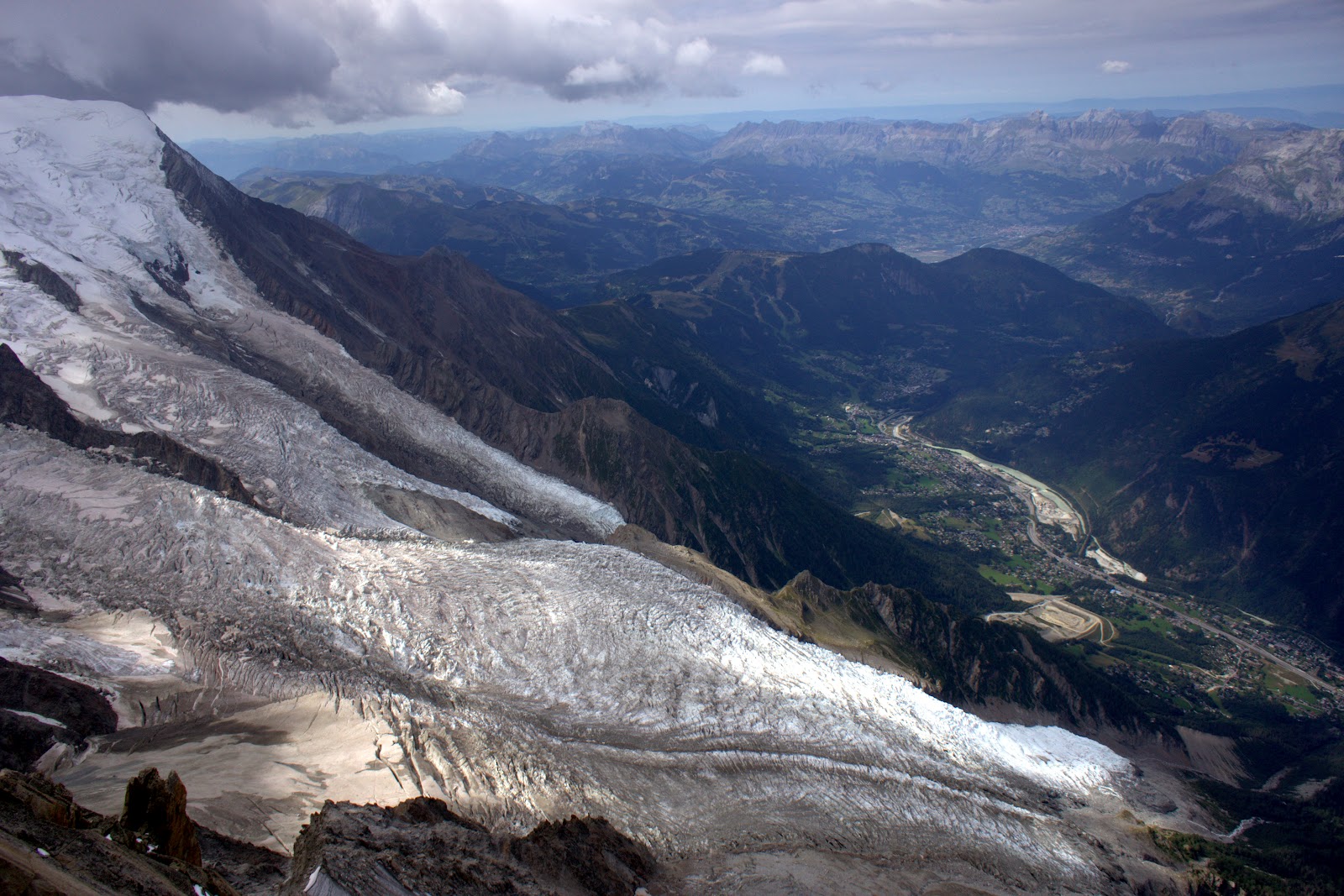
Glacier des Bossons
Shake it out, shake it out ...
And it's hard to dance with the devil on your back,
So shake him off.

The Aiguille du Midi station, built into a pinnacle at 12,000 feet before the invention of helicopters
I am done with my graceless heart,
So tonight I'm gonna cut it out and then restart.
Cause I like to keep my issues drawn.
It's always darkest before the dawn.

Climbers ascend the final ridge to Aiguille du Midi
And given half a chance, would I take any of it back?
It's a fine romance but it's left me so undone.
It's always darkest before the dawn.

Glacier du Geant
And I'm damned if I do, and I'm damned if I don't,
So here's to drinks in the dark at the end of my road.
And I'm ready to suffer, and I'm ready to hope.
It's a shot in the dark right at my throat,

Aig le Verte
Cause looking for heaven, found the devil in me.
Looking for heaven, found the devil in me.
Well what the hell, I'm gonna let it happen to me.


Monday, August 27, 2012

Chamonix

The town center is crowded and the backdrop is jaw-dropping — but there's a surreal tint to Chamonix that I haven't experienced in the similarly set national parks of North America. Maybe it's hints of old-world culture, European richness, or the simple fact that, crowds notwithstanding, the Alps have to be one of the most ruggedly beautiful mountain ranges in the world. The Himalayas, no contest; the Andes and Cordillera Blanca, of course; the Canadian Rockies and the Alaska Range, my personal favorites— but the Alps, the Alps have this way of extracting tears of joy amid cries of pain; a haven of pinnacles both inaccessible and endlessly inviting. I can't wait to attempt to hike and jog for a hundred miles in the shadow of Mont Blanc.

I'm writing a quick blog post while Beat packs up for La Petite Trotte a Leon, which starts today (Monday) at 10 p.m. Chamonix time (1 p.m. PDT.) PTL is 290 kilometers of trail with some 22,000 meters of elevation gain. Some of the steep ascents and descents are on class-four and even low class-five terrain assisted by fixed ropes and cables — essentially climbing routes without the harness, called via ferrata. UTMB is likely going to be the toughest single-effort physical challenge I've ever taken on, but PTL is at least three times as difficult. Beat told me he will be carrying a tracker and I am hoping to follow him on the PTL map page. There is also a "Live Page" that may have updates.

Meanwhile, I have the fear firmly planted in my heart, and so I am going to make every effort to approach Friday as well-rested and healthy as possible. I plan to get out for a few short hikes in the next three days, but it's honestly going to be a mental battle to refrain from binging heavily on these beautiful mountains before my race begins Friday evening. I keep telling myself I'll have plenty of exposure to the Alps this weekend, but the Chamonix backdrop makes it hard to sit still. The rest of the plan includes lots of sleeping, eating pasta and bread, and watching Beat's updates as he makes his way through these amazing mountains.

Edit: The tracking site is located here, showing a Google Earth image of the course and the racers' locations. Beat and Daniel's team is "Too Dumb To Quit." Our friends Steve and Harry also are racing PTL, and their team is "Quit Is A Four-Letter Word." 
Saturday, August 25, 2012

Switzerland

Beat and I have spent the past few days visiting Beat's family in Switzerland. Thursday was Beat's brother Andy's fiftieth birthday. We traveled to Interlaken, a idyllic little village in the foothills of the Bernese Alps, where Andy and his wife went skydiving in the morning. We had previously declined an invitation to join them, citing nervousness about injuries before our big races (About seven years ago, I went on a tandem skydive where the instructor misjudged the landing and put us down extremely hard, bruising my tailbone. I was unable to walk normally for a week after that.) Of course, as soon as I saw those parachutes sailing through the clear blue sky amid glacier-capped peaks, I regretted passing up the opportunity. I'm not even an adrenaline junkie (I'm an endorphin junkie, and there's a huge difference.) But I can only imagine what the views were like from those heights, in free-fall.


We did get a glimpse of the views, minus the free-fall, when we took a helicopter ride from Interlaken back to Andy's house, where it landed in a farm field next door. A thick haze had moved in before we took off, so I wasn't able to capture a good aerial photograph. But it was my first time in a helicopter, and also an opportunity to see rural Switzerland from the sky. Even the "flat" region is a continuous ripple of hills covered in a patchwork of forest, green fields, and clusters of villages woven together by veins of roads. Besides the the airborne adventures, there has been a steady stream of awesome food — pizza, cheese, cake, crusty bread, salad, cheese (the Swiss love their cheese. This love is completely justified.) I don't have to worry about showing up for UTMB without ample calorie reserves.


I've also been able to do a few taper runs. I try to keep them to ninety minutes or less, but it's been difficult to restrain myself since I found a scenic network of logging roads a couple of miles from Andy's house. Despite generally low energy levels (I always struggle with jet lag, and even after three days I still haven't been able to sleep through a night), all I want to do is explore these hills all day long. It's a beautiful region full of adorable farmhouses, narrow roads, green hillsides, lush forests, and old churches. I've really enjoyed my runs here, and we haven't even gotten into the real mountains yet.

We leave Sunday morning for Chamonix. Beat's race, La Petite Trot a Leon, starts Monday evening. My race doesn't start until Friday evening, so I'll have a bit more time to fret before the big hurt begins. I'll probably write blog posts about the gear in my huge backpack and how I plan to ration my limited supply of peanut butter cups to pass the nervous time. I finally packed up all of my gear today and the verdict — nine pounds without water, but including food. I'm going to try to think about ways to pare that down as best I can without sacrificing too much of my "safe" food (I'd hate to time out of UTMB because I can't eat anything.) On to France. 
Monday, August 20, 2012

Packing up

This weekend has been a frenzy of packing, shopping, and re-packing. We leave for Switzerland on Tuesday, so I need to have everything ready to go before then. Beat hoisted my UTMB pack and proclaimed, "There's way too much stuff in there. You need to get rid of some of that."

"I can't," I protested. "That's just the required gear. I don't even have any food in there yet, and except for some meds and batteries, it's all obligatory." I'm not yet willing to rely entirely on fontina cheese and dried meats for the duration of a hundred-mile foot race, so I will be packing my own supply of gummy candies. This backpack is heavy. I try to put it in perspective, remind myself of my Susitna sled, of all the water I carried on my back during the Stagecoach 400, but that doesn't make me feel much better. The backpack is my first tangible dose of truth — this thing is about to get real.

So what is UTMB? It occurred to me that I've never really explained this whole endeavor. UTMB stands for Ultra Trail du Mont Blanc, and it's a 166-kilometer foot race on a route that begins in Chamonix, France, and circumnavigates the highest mountain in the Alps, the 4,808-meter (15,774-foot) Mont Blanc. The Trail du Mont Blanc travels through France, Switzerland, and Italy, ascending and descending a series of cols (passes) and ridge traverses for a total of 9,500 meters (31,168 feet) of climbing. The raw numbers rival the Hardrock 100 and UTMB is regarded as one of the toughest ~100-mile-distance foot races out there.

It's also undoubtedly the largest race of this distance, drawing a limit of 2,000 runners. It's a big crowd. I have little knowledge about who's lining up for the 2012 race. I do know an overwhelming majority of them are European men. In 2011, out of about 2,000 starters, 1,133 finished. Of those 1,133 finishers, only 72 were women. The first man, trail-running legend Kilian Jornet, finished in 20 hours and 36 minutes. The first woman, Elisabeth Hawker, finished in 25 hours and 2 minutes. A sub-36-hour finish would have landed a man in the top 175, and a woman in the top ten. Nearly 700 of the finishers needed more than 40 hours to return to Chamonix. Forty-seven of the 72 women had 40-plus-hour finishes. Everyone in the race is given 46 hours to complete the distance. Those who fall behind the pace are stopped by checkpoint cut-offs.

Yes, numbers show that this is a prohibitively difficult race. So how did I get involved in this? It started about a year ago, when I timed out at the Tahoe Rim Trail 100, because of slowness caused by disruptive foot pain. I decried the TRT100 for being too "runnable" and declared that a hiker like myself might actually fare better in a tough mountain hundred where solid climbing ability paired with persistence can make up for less-than-stellar running skills. Plus, I love the idea of a long-distance endurance hike, which is why I've had so much enthusiasm and relative success in the foot division of the Susitna 100. I didn't choose UTMB because it's one of the "hardest" races, I chose it because it matches both my desires (long trip through beautiful mountains) and my abilities (endurance, persistence, and climbing.) But it's still a really, really hard race.

Today I did my last run up Black Mountain before we leave for Europe. Black Mountain has become a go-to training route — the trail is a five-mile, 3,000-foot climb of variable steepness that requires some walking even at max effort, followed by a fun five-mile descent. For my birthday, Beat bought me a new pair of Hoka Mafate shoes that I'm loving, as well as a pair of Salomon calf sleeves to help support my weak shins and also so I will fit in with the Euro runners. I'm in taper mode right now and feeling strong, so I logged a good time for the ten-mile run today: 2:00:01 with stops. It was fairly effortless (no hard pushing because of taper mode and also self-preservation on the descent), so I was feeling a bit smug at the bottom. "Ha, Black Mountain was easy today. It's basically a tenth of UTMB. I just need to add a lot more technical terrain, at higher elevations, over two nights, with potentially awful weather, times ten." Yeah, that shut my smugness up real quick.

Panic will resume soon enough. But I genuinely am excited for all of it. I'm excited to travel a hundred miles through three different countries on my own two feet, to gaze up at the stunning profile of Mont Blanc, to try to decipher French at aid stations, to experience the grandeur of the Alps and the energy of 2,000 racers. Friends have asked me why I would even want to participate in a mountain event with so many people, but to me, that's all part of the experience — the crowds, the glaciers, the cheese and dried meat, the unbelievable vistas, the soaring highs and emotional breakdowns, and the crushing, crushing foot pain.

Everyone who attempts these hundred-mile foot races has their own reasons. I've described my motivation as a desire "to paint the canvas of my memories with bold red brush strokes." If this were purely about the beauty of the Alps, I would backpack the route over eight days like a normal person. And if it were purely about ego, honestly, I would probably be attempting something decidedly more suited to my actual talents. The UTMB project is about paring down all the complicated facets of myself to a stark minimum, to silence the excess noise and embrace the bare thoughts and emotions that remain. To be alone in a crowd of 2,000. To feel the energy of 2,000 people when I feel alone. To fight for every hour and surrender my ego to the beauty. As Florence and the Machine sings: "Leave all your loving and your longing behind; you can't carry it with you if you want to survive." ("Dog Days" is becoming my UTMB training theme song.)

But that's still a week and a half away. For now I'm just trying to quell panic and maybe get in one last pre-UTMB bike ride on my birthday, which is today (Monday.) 
Wednesday, August 15, 2012

The consequences of experience

I don't have any of my own photos of Michael Popov, only a few from the day I met him, during my first ultramarathon, the Rodeo Beach 50K in December 2010. 
One week ago, a man who is well-known in the Northern California trail-running community died from complications of heat stroke in Death Valley. Like many do in this social media age, I learned of his death through vaguely worded Facebook posts and wondered what could have possibly happened. Michael Popov was an experienced endurance athlete, a formidably built Russian with a long resume of adventure racing and self-supported fastpacking treks. When initial reports said he ran out of water during a recreational, six-mile traverse between two parallel roads, I thought "that doesn't sound right." Today, Outside Magazine published a more detailed account of what happened during a "routine run" in one of the most extreme environments in North America. The story is enough to bring pause to anyone who considers themselves an adventure athlete — the experience we take for granted, and the decisions we make every day.

Although I didn't know Michael well, his death resonated deeply. He and I were about the same age, and shared many of the same passions. He was co-director for Pacific Coast Trail Runs before that venture closed its doors earlier this summer, so my memories of him are from chats after 50K trail races. Our conversations usually centered around endurance bikepacking, and he told me he wanted to ride the Colorado Trail Race in 2013. The last time I saw Michael was at the Diablo Marathon in June. He handed me a coaster for winning the race and teased me about showing up in Banff the following week for the Tour Divide. "Who knows?" I replied. "Maybe I will. What's your next big adventure?" He just shrugged and broke into a disarming smile. "Maybe see you at Tour Divide?" he joked. From others' accounts of Michael, this seemed to be a big part of his personality — lightheartedness, but with an underlying focus and intensity.

Michael's last run was a spur-of-the-moment decision to travel cross-country between West Side and Badwater roads in Death Valley. He estimated the distance would be about ten kilometers, and likely thought the run across flat terrain would take about an hour. His partner was set to pick him up on the other side of the traverse. He packed four bottles of water, and only a cell phone as an emergency measure. It was approximately 2 p.m. and the temperature was 123 degrees. Two and a half hours later, passersby found him lying on the side of the road. He was conscious but delusional and combative. After emergency crews were summoned, he lost consciousness, and died during resuscitation efforts. The doctor who performed the autopsy speculated that Michael likely encountered subsurface moisture beneath a thin crust layer, which can make footing extremely difficult. If he had to find a way around it, his route would have been significantly lengthened. His water bottles were empty when he was found.

Those of us who don't know Michael well can only wonder what he was thinking when he decided to embark on his run, as well as what went through his mind when he realized he was in much deeper than he anticipated. Michael, who has completed the 135-mile Badwater ultramarathon, probably had good reason to believe that his relatively light kit was more than enough for conditions he had dealt with before. His experience rightfully gave him confidence, and still a stark misjudgment occurred. It's a sobering lesson for anyone drawn to these extreme environments, where the margin for error is so thin.

On Monday, our friend Daniel came to visit from Colorado and we went for a run on Black Mountain. He told me he had been reading my book "Ghost Trails" and was curious about the incident during the 2008 Iditarod race when I dropped my bike in an open stream in the Dalzell Gorge at 20 below, and soaked my leg as I retrieved it. What he didn't understand, he said, is why I didn't get frostbite when that happened, but did in a similar incident the following year.

"Well, it's interesting," I replied. "I realize now how many poor decisions I made after I went through the ice on Flathorn Lake in 2009. But at the time, that incident in the Dalzell Gorge was still fresh in my mind. The year before, I completely soaked my boot in temperatures far below zero, and proceeded to push my bike to Rohn over the next eight hours with no consequences. So you see, there was that precedent that made me think I'd be okay."

Only the second time around, I wasn't as lucky. I was still lucky that I was able to walk away with moderate frostbite and not something much worse, but still, I sometimes wonder — what was so different about conditions in 2009 that my foot froze in eight hours? Was it because it was a few degrees colder? Was it because of wind? Was it because I both pedaled and pushed my bike, where in 2008 I walked the entire way? What will I do if I encounter similar conditions again? I love the frozen Alaska tundra more than any other landscape I've experienced, and I'm not going to stay away. Instead, I want to be prepared. I want to be alert. I want to make good decisions.

Still, I recognize that I can gather all the experience and knowledge possible, and still make a disastrous mistake in a relatively routine situation. It's even more likely to happen if experience gives my mind precedent to believe that a particular situation is okay. But of course, situations can change stunningly fast. And when conditions shift outside one's experience, even small miscalculations can turn deadly. Michael's final run has been a sobering reminder of that reality.