Monday, February 27, 2006

It's a struggle

Date: Feb. 26
Mileage: 13.2
February mileage: 414.9
Temperature upon departure: 22

One thing that makes winter cycling so exciting and yet so frustrating at the same time is its total lack of predictability. Sure, you can gage weather conditions, new snow, temperature, etc. But you're never going to know what a trail will be - or become - until you're right on top of it. You could go out for a 13-mile ride that you'd successfully pounded out in less than an hour in the recent past, and watch it take you more than two.

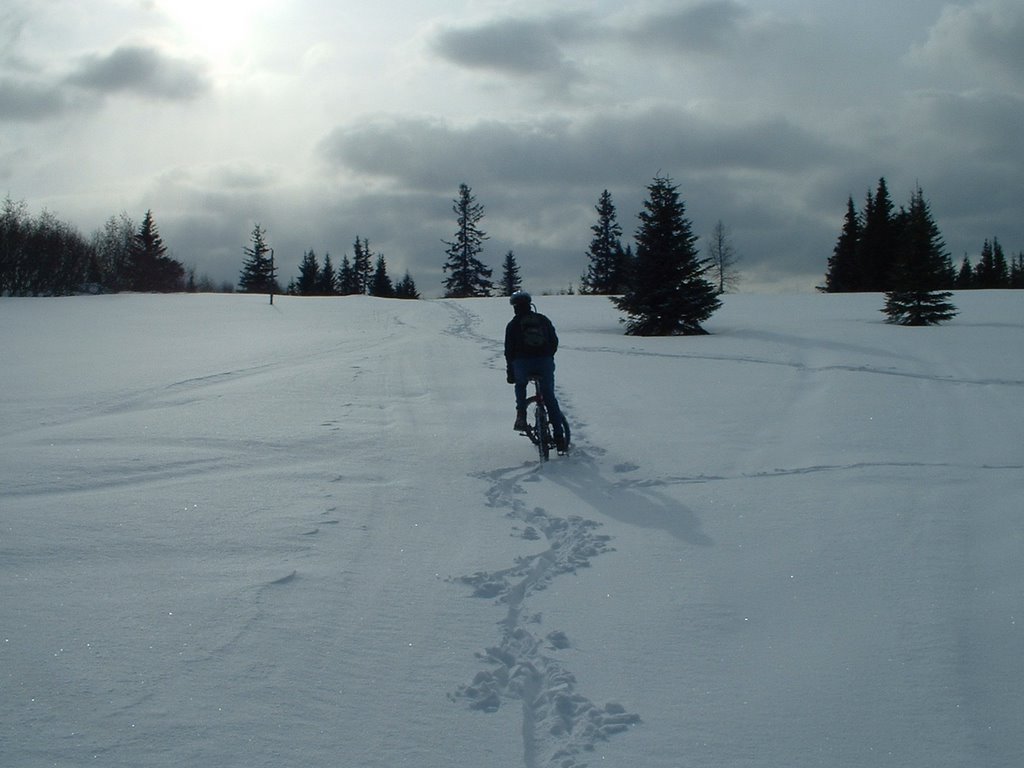
Geoff and I went out for what was going to be our easy, pre-ski ride and spent over two hours navigating conditions that dangled on the precipice between rideable and not. Even the roads, which yesterday received about four inches of snow (not enough to plow on a weekend), were zig-zagging, fish-tailing affairs. On the trails we met soft, deep and sometimes all-together untrammeled snow (had I had my snowboard with me, I probably would have giggled with joy.) I enjoyed the challenge of trying to pedal through stuff that very recently I would have deemed unrideable, but there are only so many times you can bury your front tire in a drift and slam your crotch into the handlebar stem before you start asking yourself - why? (I'm sure if I were a member of the opposite gender, that question would have been asked much sooner.)

There was some poetic justice to today's ride, as we swerved down the final steep hill to the reservoir. Geoff, who is by leaps and bounds more athletic than I am, said "You know, I have a lot more appreciation for what you did last weekend." And I know, deep down, that winter cycling isn't the classic struggle of man against man or even man against self. No, it's the much more modern, much more sinister battle of man against machine, in a place where the very tool you chose to save you can become your worst enemy.

That said, the Iditarod Invitational racers are clearing checkpoints pretty quickly. As of early this afternoon, four bikers had already passed the 130-mile point. That's 24 hours for the leaders. Now they're really moving into the Alaska Range, above treeline and onto the sweeping tundra so remote the race organizers call it "The Black Hole." As of 3 p.m., Rocky Reifenstuhl was one of two in front. His brother, Steve, is marching the 350-mile distance on foot. He did the race last year, and here's what he said about the experience:

"The edge with which I am dancing is where the mind can make the body perform beyond what is believed to be possible. It is spiritual, it is dreamlike, it penetrates to my core and when I come back from it, I know I was there, and it beckons for months afterward ... At the finish line in McGrath, the physical and the emotional unite in a crescendo of emotion, pain, elation. The "other" becomes a memory. This unique reality has been reached by the passage of miles, time, physical exertion, psychological strain and sleep deprivation. It is so close to me, yet a world away."
Sunday, February 26, 2006

Practice makes patience

It snowed most of the morning. Geoff and I went for a two-and-a-half hour cross-country skiing excursion. The sheer time on the skis helped me build confidence and some speed. It also left my hip flexors so sore that even walking now is more of a shuffle. I'm also feeling it in my much-neglected arm muscles and my Susitna "camelbak injury," a knot in my left shoulder that seems to just be getting worse. There is something to be said about cross training, and my lack thereof.

The 2006 Winter Olympic Games are almost over, and the pictures in the newspaper make me nostalgic for the balmy February nights of 2002, tearing through the crowded streets of Salt Lake City with a massive Canadian flag, just to stir things up a bit.

I came of age in the shadow of Olympic anticipation - learned to drive on streets under massive construction, lost my favorite wrong-side-of-the-tracks concert venue to a beautifying "Gateway" project, watched my alma mater squeeze out students to make way for an athletes-only Olympic village. Everything seemed to be closed down or off limits or reserved for the Olympic elite. By the time 2002 finally came around, I was about as close to anti-Olympics as they come. I thought the entire thing was an elaborate publicity sham. I thought that Salt Lake City was delusional to think it could host such an sweeping international event with any success. And I was pretty sure I was just going to hole up in some place far away and wait for them to be over.

But then they came. And I was living four blocks from downtown Salt Lake City, watching the sterile city streets transform into something colorful, loud and wholly alive. There were people everywhere - dressed in elaborate costumes, gyrating to ghettoblasters, guzzling from suddenly-legal open containers and lining up by the thousands for the free medals ceremony rock concerts. Athletes showed up at all the hot clubs. Latvians and Croatians and Slovakians were dancing in the streets. People waved flags from their balconies. How could you not get caught up in that?

One particularly memorable night, we set out with a video camera and all of the sense of a horde of 6-year-olds set loose in Disneyland. The rest of the night generated a series of caught-on-tape outtakes that at the time came so naturally, and now seem so surreal: an interview with Barney the Dinosaur, absurd arguments with anti-Mormon activists, "short-track street skating" in downhill ski boots; crashing a street rave; and taking on Canadian identities to join a group of real Canuks in full-gusto cheering.

It's kind of funny that those street parties became my Olympic experience. The only actual event I saw was the Men's Super G. Tickets were so expensive - and by the time I realized that I was in fact completely in love with the Olympics, they were over. Sometimes I wonder if I'll have to explain to my grandchildren someday about the time I was sitting right on top of the Olympics and missed them, but I don't think so. I think I saw the Olympics for what they really are - one big, surreal party. And everyone's invited.
Saturday, February 25, 2006

Tough to quit

Date: Feb. 24
Mileage: 29.9
February mileage: 401.7
Temperature upon departure: 18

Today Geoff and I went to lunch at our favorite semi-organic greasy spoon, Cosmic Kitchen (there are two types of restaurants in this town - the swank places that welcome Xtratuf-wearing locals with open arms, and the carrot-juice-brewing hippie places that also serve beef and cheese burritos the size of your head.) After months of hugging the horizon, the noontime sun ventured toward midsky, bathing the whole restaurant in white light. We took our plates into the glare of a south-facing window just as a family settled in next to us - only on the other side of the window, where snow-covered picnic tables lined the balcony. There they sat for nearly an hour - sipping coffee, munching on corn chips, soaking in sunlight - with steam pouring from their burgers and breath in the subfreezing air.

That's when I decided it would be a great day for a bike ride. I left work a little later than hoped, but I still thought it would be good to go out for an hour, absorb some vitamin D through that narrow slit in my balaclava, and come back with time to spare before Foreign Film night.

But one aspect of the Susitna 100 that I didn't anticipate letting go was this whole training thing. Giving up the multihour, four-times-a-week bicycle rides I've become so accustomed to almost feels like losing a job. I fear that suddenly I'll find myself sprawled on my coach, pouring through classifieds for used bicycle parts and struck with that hollow feeling that my life is slowly sinking into uselessness ... meaningless ... joblessness. Sure - I could get some other hobby. Find a new passion. Maybe even get a life. Sure - and while I'm at it, I could apply for new jobs. It's not as easy as it sounds.

That said, my one hour ride turned to three, as simple as cranking those pedals and wishing I had decided to bring my Camelbak with me, especially as I was laboring up the 1200-foot-vertical, 3-mile climb the locals call East Hill (I don't typically bring water on short rides, because bottles freeze in about a millisecond and the Camelbak seems like overkill.) The whole time, I had this freeing feeling that I was riding for fun again - spinning down the snow-dusted bike path on the Spit, bouncing through the surprisingly technical ice boulderfield created by snowplows along East End Road. I was riding like I wasn't trying to put in miles, so the miles just came.

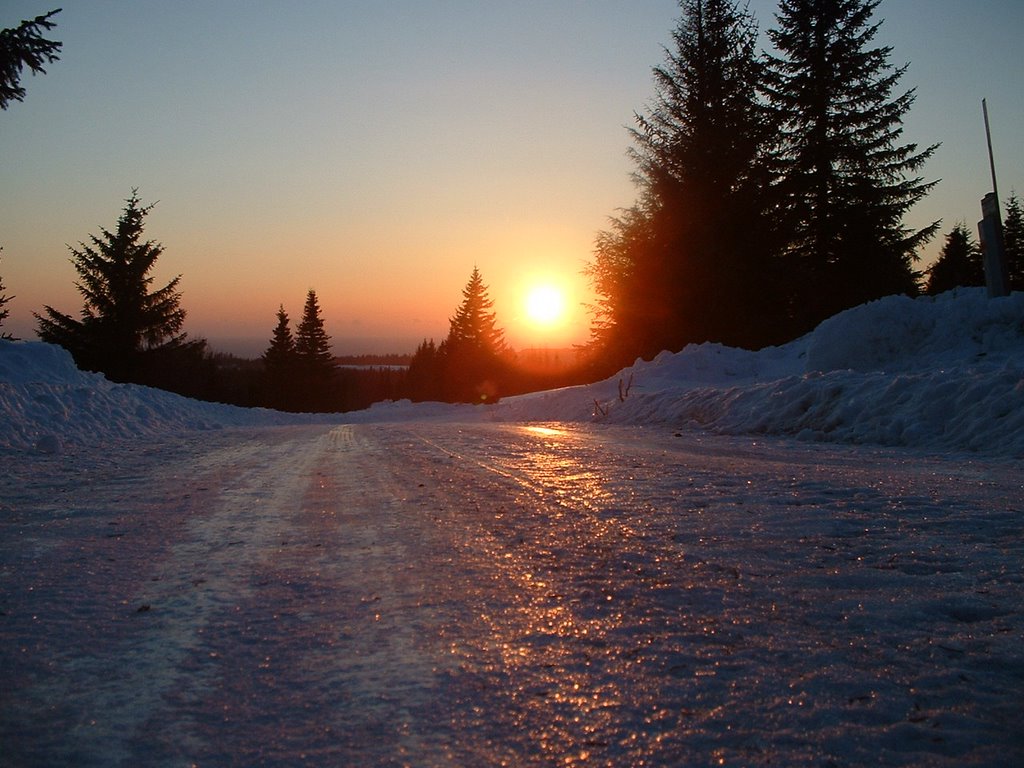
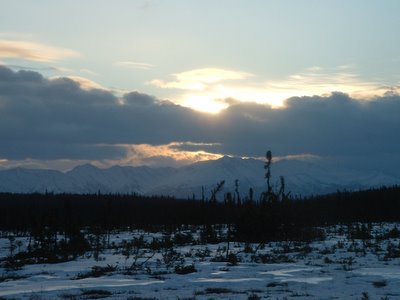
Before I knew it, the sun was slipping below the horizon. It was so far west that I could only see streaks of orange light reaching above treeline - a long way from its position in the south that I've become so accustomed to. And I knew what it felt like to be that family eating their lunch on the balcony on a 20-degree day in February. Despite all appearances, it felt good ... a rare and much appreciated afternoon in the sun.
Friday, February 24, 2006

Big dreams

Today I received a prize in the mail - a stainless steel mug that reads "Susitna 100 finisher" on it. Everyone who posted finishing times in the race wins the same. Since I've already plowed through all the Pepsi and Goldfish within chowing range, I thought I'd improvise on Kevin's request and make a self portrait of myself having my evening herbal in my "major award." Sorry, Kevin ... I can't sign it because I don't own any photo editing software. Plus, that's just an identity theft waiting to happen.

I look forward to putting this mug to good use this weekend when I kick back to watch the check-in times on the Iditarod Trail Invitational. This race makes the Susitna 100 look like a few turns down the Bunny Slope. I'd like to try it next year. I really mean that. With a little bike investment, a little more practice and a lot of workouts, it's not totally incomprehensible. By 2007, Geoff will be ready to take on the 350 miles to McGrath on foot anyway, so I sure as Susitna should be able to do it on a bike. Unless the trail conditions are bad ... how long is 350 miles at 2.5 mph?

As for this weekend, I'll be cheering on local rider Adam Bartlett, Alaska Magazine columnist Ned Rozell on skis, and my boy from back home - Eric Johnson of Utah on foot. In the long race, I'm watching out for Kathi Merchant of Chickaloon. She's a woman. She's Alaskan. And she's riding her bike to Nome. I am in awe.

I forgot to link this before, but I answered "20 questions" for Daniel of St. Louis. Daniel was kind. They're mostly softballs. But as for the Iditarod Invitational, which begins Saturday, I encourage all to join me, Tim, Old Bag and everyone else who has committed to kicking back with rich food, a warm hearth, and good vibes for those who are still out there, suffering toward wisps of glory in the endless snow.
Wednesday, February 22, 2006

Love and support

Date: Feb. 22
Mileage: 17.8
February mileage: 371.8
Temperature upon departure: 25

First "after the storm" ride today. I didn't ride much differently than I would have before Saturday - in fact, I rode a little harder because I was thrilled to see patches of bare pavement on Skyline Drive (although the majority of my ride was still atop packed ice.) I noticed I had a lot of lactic acid buildup in my legs early on - probably because my muscles are still fatigued. But some good, hard gulps of subfreezing air felt good (how I missed that air on Saturday. Really.)

One thing I didn't quite realize the extent of was the mayhem caused by the Susitna 100 Web site's failure to post my finishing time until several hours after I came in. I was back in Palmer, showered, fed and semi-rested before I called my mom - who by that time was semi-frantic. Later, I found out friends of mine in Utah had been watching my progress with some trepidation - enough put in phone calls to any race official whose number they could track down. Geoff's mom was worried. My co-workers were anxious. Even fellow bloggers Tim, Old Bag and Velocipete, who were making good on their promise to kick back with some snacks and a roaring fire and cheer me on, were posting notes of concern. And you know, that feels really good. It's nice to know that, if I was lying out on the tundra with my face in the snow, that there are people out there who would call on the search and rescue party.

When I set out on this journey, I had no idea such a great and extensive support network would rally behind me. Before the race, I received dozens of "good luck" e-mails, some from old acquaintances who I didn't think even knew I was living in Alaska. My boss greeted me upon my return with a huge basket of Pepsi, Goldfish and cereal. People from all over the world dropped in comments. Out on the trail, we may have to battle our inner demons alone, but the knowledge that others care is a powerful ammunition.

Speaking of, I never posted my "Ride all the way to the Susitna 100" fundraising results. With the help of more than 25 kind sponsors, I was able to raise $438, and ride more than 1200 "arctic" miles in the process. After I hit my original goal, the race entry fee, I still saw $213 in support - which means $107 for the Lance Armstrong Foundation, and the other $106 easily covered the cost of transportation and food (I even splurged on the turkey jerky.) Which means I did this entire race on the love and support of family, friends, cyclists and the blogging community at large. I don't even know how to begin to say thank you, but I'm open to suggestions.

Now what?

I went out for an easy 2.5-mile run today ... finally a cool down after two days laboring in a sleep-deprived haze. My knees are still a little sore. My legs are still covered in bruises from some of my tougher falls Saturday. I even still have remnants of blisters from the long trudge, but I the run definitely perked me up - helped me feel strong again. I think I'll be recovered from the Susitna 100 in no time. And now the sun stays up past 6 p.m. Twilight hangs on the horizon until 7. It may have been 25 degrees out as I jogged over the ice-slicked roads, but I felt like a season turned over. Winter ended for me out on that lonely trail. Sure, the wind and snow and subzero temps will probably haunt this place into April - but that doesn't seem to matter much. I threw myself into the bowels of subarctic winter so I'd no longer have to fear the cold. Now there's nowhere to go but Spring.

So now what do with myself? The cycling can only get better, really, because how can you do worse that ice biking? (unless Geoff's "stream cycling" ever crosses into the mainstream.) The roads today were as dry as I've ever seen them; the trails blissfully hardened by the thaw/refreeze. There's riding in me still, and I've started a quest that I'm not ready to stop. But where do I go from here? The Soggy Bottom 100? The Fireweed 200? The possibilities seem endless.

No. This isn't over.
Tuesday, February 21, 2006

Susitna sustained

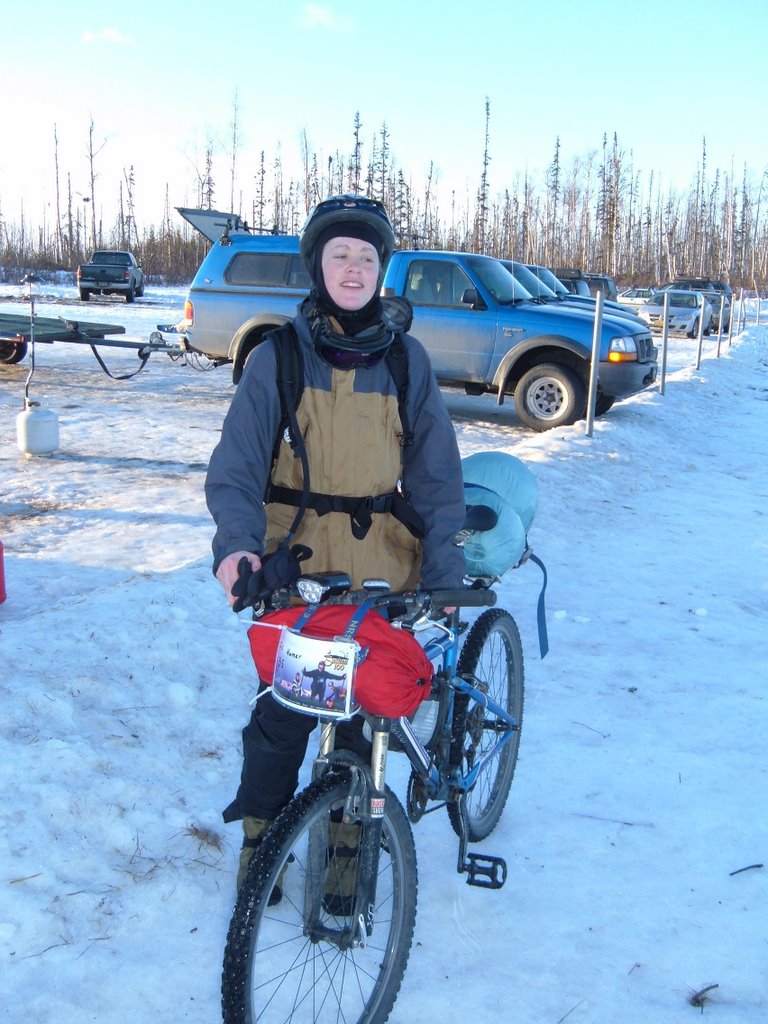
Did I finish the Susitna 100 with a smile on my face? Well, based on this photo Geoff took (that I don't remember him taking) - not quite. Actually, I look like a drunk zombie. But I gave that smile my best shot - just like the race.

Also, I forgot to mention in yesterday's post that Geoff won the foot division of the Little Su 50K. He came in first with a time of 3:54, just ahead of elite ultra-marathoner Julie Udchachon. I biked the first 25 miles of my race in about that time. He ran 31. Geoff's the champion. I'm not even a contender. But I do feel good about what I did. Really. I did something that as recently as six months ago I would have never imagined myself doing, and I had an incredible journey.

Yesterday, when I was mulling over some of the decisions I made on the trail - and the times I posted - Geoff told me, "Only you know what you did out there." He's right. The ideology behind the Susitna 100 is not necessarily to be the fastest runner or best rider. It's about pushing into the Alaska wilderness and making some tracks in the snow - whether they're tire tracks, footprints, or a swerving combination of both.

There are some ways I could have been better prepared. I knew it when I lined up next to my fellow racers, most equipped with specially-built snow bikes, wide rims, 3-4" tires and rigid forks. And there I was, straddling my rock hopper. I felt like I was standing at the startling line of the Tour de France with a beach cruiser. In conditions where flotation was everything, that analogy isn't really isn't that far off. But I did the best I could with what I had. And, for its highs and lows, its lonliness, pain, joy, beauty and desolation - the experience was amazing.

What was the best moment of my race? It happened as I was cruising across the Susitna River on the first leg of the race. I looked toward Mount Susitna, bathed in golden air and shimmering in the sunlight. Across the river I saw a gray shadow dart into the woods. I convinced myself it was a wolf. I'll never know if it actually was - but I felt absolutely inspired. I don't think it matters what your religion is, or if you even have one - it's in these moments that you see God.

And the worst? Ironically, that happened in nearly the same spot, just after I had climbed out of the Susitna River on the incoming stretch. It's a place they call Dismal Swamp, a bog even by winter standards. Rain was coming down hard. I had just spent the last two hours spinning in my lower gears through the deteriorating conditions. When I got to the swamp, my forward motion stopped all together. All I could do was spin a few inches deeper into the soft snow before I fell over. I got off to push but the bike still knifed into the snow, making even the walking tedious. Even my body felt bogged down. I stopped to check my clothing situation and realized my "water resistant" winter coat had given up the fight. My lower layers were dripping, my gloves were dripping, my nose was dripping. I don't think it matters what your religion is, or if you even have one - it's in these moments that you pray for miracles.

That's the moment I've agonized over a bit since Sunday morning. I worry I may have given up on the Susitna at that point - walked out because, well, I had to. I knew I would have to deal with some bad conditions, but it seemed like they hit me harder than they hit other bikers still on the trail when the rain hit. It could have been my "skinny tire" bicycle. It could have been my inexperience. For what it's worth, I did try to ride through that last leg. Continually. I would get back on the bike for short stretches. Swerve a bit. Hit a snowbank. Stop. Walk some more.

It's hard not to second-guess the decisions you make in the middle of the night. I haven't pulled an all-nighter since I worked at Einstein's Bagels in college. I forgot how precariously unbalanced my mood can become, and I had some amazing swings during the race. One minute I'd be lying with my helmet in a snowbank after one of the many sideways falls I took, on the verge of sobbing and contemplating just staying there, crumpled in the snow. The next I'd be back on my bike, singing along at the top of my lungs to a lovably dated TLC song on 3 a.m. radio ... "I don't want no scrub ... Scrub is a guy that can't get no love from me." Just about every emotion I had was terribly exaggerated.

But through all that, I forced myself to keep some perspective. I thought about other moments on my bike that took me to the edge of my breaking point, and how I got through them. I thought about all the people back home - and across the world - that might be cheering me on, even at 3 a.m. I asked myself if I'd rather be pushing my bike through the dark Alaska wilderness or baking bagels in some lonely, starchy kitchen. And I realized that there were some people beneath the orange glow of Anchorage city lights on the distant horizon that had it even worse than me.

Would I do it again? In a heartbeat. I can overanalyze my performance until my fingers hurt, but the truth is, what I did was go out for incredibly beautiful - incredibly long - bike ride. That's all. Anyone could do the Susitna 100, but the real joy of it is it takes you to places so few see. It takes you to the edge of the brutal, lonely wilderness and it makes you look deep inside yourself. You have to ask yourself some hard questions. You have to get a grip on your limitations. And, when things are really looking bad, sometimes you have to sing some bad '90s pop music just to get through it. What a great way to be inagurated into the Alaska lifestyle.